
Welcome to Health Policy Institute
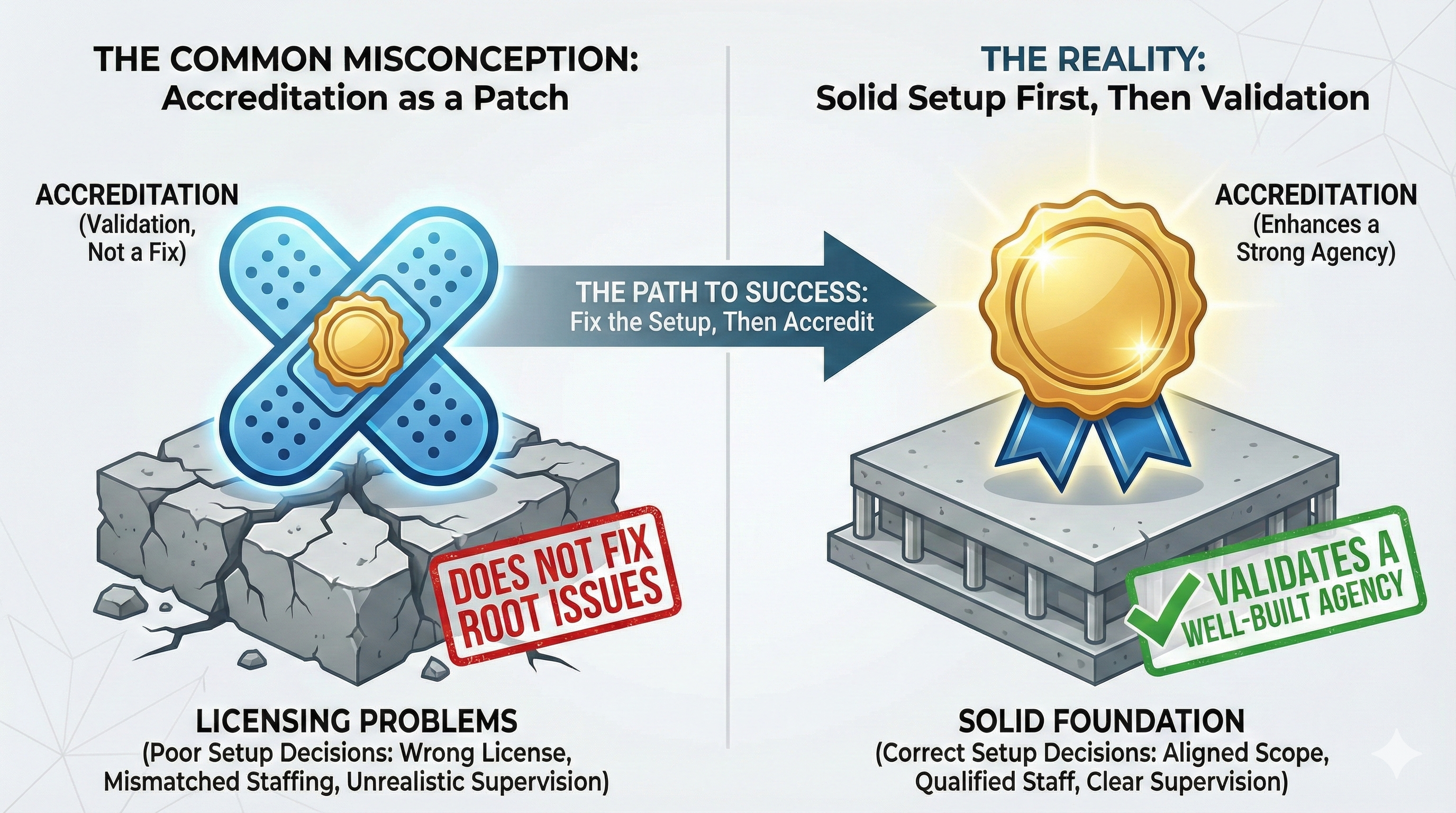
No. Accreditation does not fix licensing problems caused by poor setup decisions. Accreditation can validate a well-built agency. It cannot “patch” an agency that picked the wrong license pathway, wrote the wrong service scope, or built a staffing model that doesn’t qualify. If your application submission is being returned or delayed, adding accreditation usually doesn’t solve the root issue. It often adds time, cost, and more documentation—while the real setup problem stays in place. Why founders think accreditation will fix licensing This is the common logic: “My license application is stuck. If I get accredited, the state will take me more seriously.” It’s understandable—but backwards. Licensing / Accreditation reviewers are looking for alignment between: Service scope Staffing qualifications Supervision structure Required documentation Accreditation only helps when those setup decisions already match the pathway.
"What accreditation actually does (in plain language)”Accreditation is an outside organization confirming your agency meets its standards for a specific service type. That’s it. Accreditation does not automatically: change your license category correct a service scope that doesn’t match your pathway make unqualified staffing “acceptable” fix a missing or unrealistic supervision structure replace required state documentation In some settings (especially certain Behavioral Health program categories), accreditation can be part of the licensing route. But even then, accreditation works within a correct setup—it does not repair a broken one. The hard truth: licensing problems are usually setup problems Most “licensing problems” are not about forms being messy. They are about setup decisions being unclear or mismatched. Here are the most common setup issues that accreditation won’t fix.
1) Wrong license choice Example: You apply under an RSA-type pathway, but your service scope reads like behavioral health treatment. Getting accredited doesn’t change the fact that your service scope doesn’t match the license pathway. Outcome: the application submission is still returned or delayed—because the reviewer still can’t approve the mismatch. 2) Service scope that’s too broad or mixed Example: You want to offer supportive services, clinical services, and developmental disability services under one “general” description. Accreditation won’t make the service scope clearer. Reviewers still need a defined scope that fits the pathway. Outcome: the file stalls while you rewrite services, then rewrite staffing, then rewrite policies. 3) Staffing qualifications don’t match the services Example: Your service scope implies licensed clinical oversight, but your staffing model is mostly unlicensed roles with no clear clinical supervisor. Accreditation does not change staffing qualifications expectations tied to your pathway. Outcome: you still have to rebuild the staffing model and supervision structure. 4) Supervision structure is missing or unrealistic Example: One person is listed as supervising everything, but the service scope requires different types of oversight. Accreditation won’t fix unclear supervision. Both licensing and accreditation processes expect your supervision structure to make sense for your service model. Outcome: you still get stuck explaining who supervises what—and how.
5) Policies feel copied or “forced” Example: Your policies reference roles you don’t have (Clinical Director, QI Manager, etc.) or describe services you aren’t providing. Accreditation doesn’t fix mismatch. It often exposes it faster. Outcome: you spend time rewriting required documentation you should have aligned before you ever pursued accreditation. When accreditation does help Accreditation helps when the agency setup is already correct and stable. That means you already have: a clear service scope that matches your license pathway staffing qualifications that match the services a workable supervision structure policies and required documentation that reflect what you actually do In other words: accreditation can strengthen a strong setup. It can’t rescue a weak one. A quick self-check: are you using accreditation as a shortcut? If you answer “yes” to any of these, accreditation is probably being used the wrong way: “We’re not sure the license type is right, but accreditation might cover it.” “Our staffing plan doesn’t fully qualify yet, but accreditation will make us look ready.” “Our policies are generic, but we’ll fix them after we’re accredited.” “The application submission was returned or delayed, so we’re switching to accreditation.” That’s not a strategy. That’s a detour. What to do instead (before you spend money on accreditation) If licensing is stuck, go back to the setup decisions first: Confirm the correct licensing / accreditation pathway for your service scope Tighten the service scope (what you will and will not provide) Align staffing qualifications and supervision structure to the service scope Align required documentation to the real operating model Only then decide whether accreditation is required, helpful, or unnecessary This is how you reduce rework and protect your approval timeline. Where HPI comes in (pre-application) HPI helps agencies before they submit, when problems are still cheap to fix. We focus on the setup decisions that prevent returned or delayed applications: matching the license pathway to the real service scope aligning staffing qualifications and supervision structure to the services making sure policies and required documentation match what the agency will actually deliver deciding whether accreditation is required for the pathway—or just being chased out of fear Accreditation can be valuable. But it only works when the setup is right.
Bottom line Accreditation does not fix licensing problems caused by poor setup decisions. If your service scope, staffing qualifications, supervision structure, and required documentation do not match your pathway, accreditation is not a solution. It’s an extra layer on top of a misaligned foundation. Fix the setup first. Then accreditation can actually help.
References References (Clickable)
- Maryland Behavioral Health Regulations Hub – Shows accreditation-linked licensing pathways for some program types:
https://health.maryland.gov/regs/Pages/10-63-01-10-63-06-Behavioral-Health-Regulations-%28.aspx- CMS Overview Page on Accreditation for Certain Supplier Categories – Example of how accreditation can be recognized by CMS depending on provider type:
https://www.cms.gov/medicare/health-safety-standards/quality-safety-oversight-general-information/accreditation-advanced-diagnostic-imaging-suppliers- NCBI Bookshelf – Medicare/Medicaid Accreditation and “Deemed Status” – Explains what accreditation does in participation contexts:
https://www.ncbi.nlm.nih.gov/books/NBK597359/- Maryland RSA Overview – Useful for understanding how license category ties to service scope:
https://health.maryland.gov/ohcq/Pages/Residential-Service-Agencies.aspx- COMAR 10.22.02.10 – Example of required documentation expectations for DDA providers (policies must match the service model):
https://www.law.cornell.edu/regulations/maryland/COMAR-10-22-02-10