
Welcome to Health Policy Institute
You’re ready to serve kids. You’ve got a service idea, a name, maybe even a clinician lined up. Then Autism Waiver hits you with the reality: this isn’t a single “license and done” pathway. It’s a program that sits at the intersection of schools, healthcare, and Medicaid. That’s why the setup takes extra steps. If you plan for those steps early, the timeline makes sense. If you don’t, you end up rebuilding your service scope, staffing model, and paperwork midstream—right when you thought you were “almost ready.” The story most founders live (and why it happens) Most first-time founders assume Autism Waiver works like this:
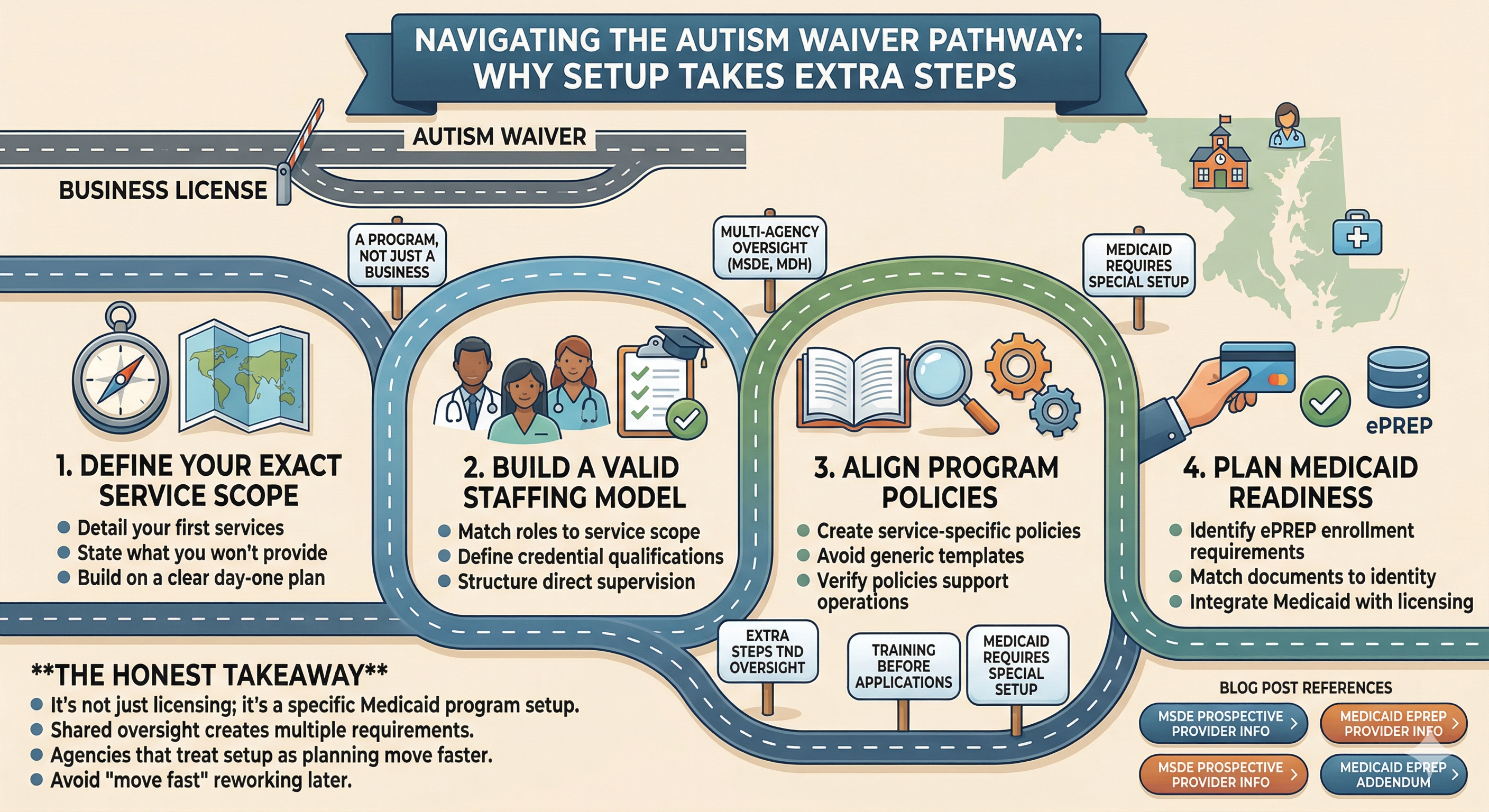
“I’ll get my agency licensed, then I’ll enroll in Medicaid, then I’ll start services.” But Autism Waiver setup often looks more like: “I need to prove I understand the program, align to program expectations, and set up correctly for Medicaid enrollment—before I can operate as an Autism Waiver provider.” That’s the “extra steps” feeling. It’s not random. It’s because Autism Waiver isn’t just a license category—it’s a Medicaid Home and Community-Based Services waiver with its own rules and oversight structure. Why Autism Waiver needs extra steps (plain English) 1) Autism Waiver is a program, not just a business type Some services are regulated mainly through healthcare licensing. Autism Waiver is different: it’s tied to a specific waiver program for children with autism, with defined service expectations and how providers participate. So reviewers and program staff are not only asking, “Are you a legal agency?” They’re asking, “Are you set up for Autism Waiver services the way the program expects?” That means your setup has to be tight. 2) More than one agency is involved by design Autism Waiver isn’t owned by a single office. In Maryland, MSDE and MDH both show up in the provider education and program communication, and the pathway touches Medicaid enrollment. That multi-agency structure is the main reason founders feel like there are “extra steps.”
3) Training happens early because mistakes are expensive Maryland’s Medicaid addendum for Autism Waiver provider enrollment states that prospective applicants must attend the Autism Waiver Initial Provider Training and Information Session before submitting an application. That requirement exists because Autism Waiver providers aren’t just opening a business—they’re joining a program with specific service definitions and expectations. Training is the program’s way of reducing wrong setups before people submit. 4) Medicaid enrollment adds program-specific requirements Autism Waiver providers enroll through Maryland Medicaid’s ePREP system using provider addenda (Autism Waiver is listed among the addenda). And federal Medicaid rules require states to verify provider licensure where applicable. That means your licensing status and your Medicaid enrollment setup need to match cleanly—or you lose time fixing records. What founders should plan before they start (setup, not process) If you want Autism Waiver to move faster, focus on planning decisions—not paperwork speed. 1) Decide your exact service scope Autism Waiver setup goes sideways when agencies try to be “everything.” Be clear about: what services you will provide first what you will not provide (yet) what your agency is built to deliver day one
If your scope is vague, everything else becomes vague—staffing qualifications, supervision structure, and documentation. 2) Build a staffing model that matches the service scope Autism Waiver is not a place to guess at staffing. You need a staffing model that answers, in plain language: who delivers each service what credentials they must have (staffing qualifications) who supervises the work (supervision structure) If your model depends on “we’ll hire later” for key roles, your application and enrollment path tends to stall—because the setup doesn’t look real yet. 3) Align your policies to your service model (don’t use generic policies) A common Autism Waiver mistake is using generic policies written for a totally different type of agency. Reviewers and enrollment teams compare your policies to your service scope and staffing model. If they don’t match, you get stuck rewriting—usually after you already submitted. 4) Plan for Medicaid readiness while you plan licensing For Autism Waiver, Medicaid isn’t an “after we’re approved” project. It’s part of the same planning lane. If you build your agency setup without thinking about Medicaid enrollment requirements, you end up reworking your provider identity, documents, and service model later—right when you want to launch.
The honest takeaway Autism Waiver takes extra steps because it’s not just licensing. It’s a program with shared oversight and Medicaid enrollment requirements. That structure is why agencies that “move fast” without locking setup decisions often lose time. The agencies that move faster are the ones that treat Autism Waiver like what it is: a program-specific setup with clear service scope, qualified staffing, a workable supervision structure, and documentation that matches reality.