
Welcome to Health Policy Institute
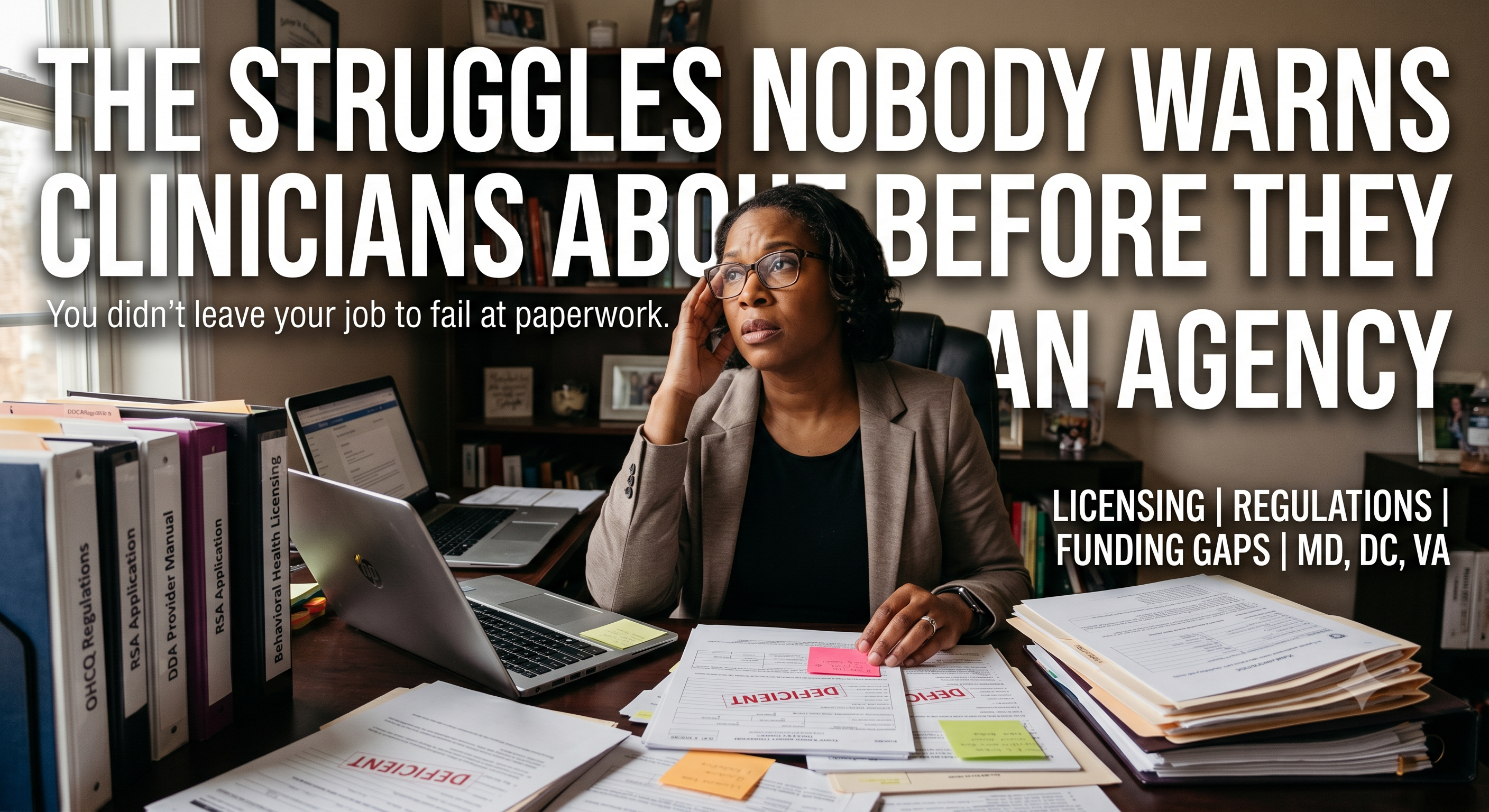
You didn't leave your job to fail at paperwork. You left because you were done watching other people run agencies you knew you could run better. You had the skills, the client relationships, the clinical instincts, and the drive. You made the decision. You started moving. And then the process hit you. Not the care part — you had that handled. The other part. The forms that don't make sense. The policies that come back deficient for reasons you still don't fully understand. The business documents the state keeps asking about. The Medicaid enrollment process that nobody mentioned while you were focused on getting licensed. If any of that sounds familiar, you're not alone. These struggles show up in almost every clinician-founded agency we've seen in Maryland, DC, and Virginia — across RSA, DDA, and behavioral health. The clinical background is solid. The regulatory and business side is where things break down. Here's what those struggles actually look like — and why they happen.
Struggle 1: Thinking You Understand the Process Before You've Learned the Rules Most clinicians come into licensing with confidence. That's not a bad thing — confidence is what makes you take the leap in the first place. But there's a version of that confidence that becomes a problem early: assuming that because you've worked inside a licensed agency, you understand how licensing works. Working inside a licensed agency means someone else handled the licensing. You saw the end result. You didn't see the application, the deficiency notices, the rounds of revisions, or the months it took to get there. That assumption — "I've been in this space for years, I know how this works" — leads clinicians to start the process without doing the groundwork. They skip research they think they don't need. They submit applications they haven't verified. And when problems come back, they're caught off guard. The process in Maryland is specific. DDA services, RSA licensing, and behavioral health programs each have their own regulatory structure, their own required documents, and their own review standards. Familiarity with the services doesn't transfer to familiarity with the process. Shape Struggle 2: Writing Policies the Way You Document Care Clinical documentation and regulatory policy writing are not the same thing — and this difference costs clinicians more time than almost anything else in the licensing process. When you document care, you describe what happened, what you observed, and what you decided. When you write regulatory policies, you describe how your agency is structured to make decisions, what standards it holds itself to, and how it will respond to a defined set of situations — in language that matches the state's regulatory framework. A clinician who writes policies from their clinical instincts produces a document that reads like a care plan. It's thorough. It's thoughtful. It describes excellent care. And it comes back deficient because it doesn't address the administrative, supervisory, and compliance standards the state is actually checking for. This struggle is especially common in DDA and RSA applications, where the policy requirements go beyond clinical practice and into areas like incident reporting structures, employee supervision protocols, and rights protection frameworks. These aren't clinical topics. They're operational and regulatory ones — and they require a different kind of writing entirely.
Struggle 3: Not Knowing What "Complete" Actually Means Ask most clinician-founders if their application is complete and they'll say yes. Ask a reviewer the same question and the answer is often different. The gap is in understanding what "complete" means in a licensing context. It's not just every form filled out. It's every form filled out correctly, every attachment included, every document consistent with every other document in the file, and every policy matching the license category and service scope being applied for. Clinicians who are organized in their clinical work assume that same organizational standard applies here. But a licensing application isn't organized like a medical record. It's organized like a regulatory file — and the standards for what makes it complete are specific, detailed, and not always obvious from reading the forms alone. The most common result: an application that feels complete to the person who submitted it and arrives at the reviewer's desk with multiple deficiencies. Not because anything was overlooked carelessly, but because the standard for "complete" was never fully understood going in. Shape Struggle 4: Underestimating How Long the Financial Gap Will Be Clinicians who are used to getting paid for their work — session by session, visit by visit — are often unprepared for the financial structure of running an agency during the pre-revenue phase. From the day you start building your agency to the day your first Medicaid payment comes in, there is a gap. Licensing takes time. Medicaid enrollment adds more time after that. During all of it, fixed costs run — rent, insurance, payroll, administrative expenses. Revenue doesn't start until enrollment is approved and services begin. For a clinician who has been earning a steady income, this gap feels different than it looks on a spreadsheet. The abstract plan to "cover costs for six months" starts feeling very real when month four arrives, the license still hasn't come through, and the original budget is running low. Clinician-founders often underfund this gap because they're optimistic about the timeline. When delays push that timeline out — through deficiency notices, enrollment processing, or both — the financial pressure becomes a serious operational risk. .
Struggle 5: Trying to Handle the Business Side Alone Clinicians are trained to be self-sufficient. The instinct to figure things out independently — to research, to work through it, to not ask for help unless it's serious — is deeply ingrained in clinical culture. That instinct keeps a lot of clinician-founders in their own way for longer than necessary. The licensing process in Maryland is specific enough that general research only gets you so far. You can read the OHCQ regulations, the DDA provider manual, the BHA licensing requirements — and still not know what a complete application looks like for your specific license type and service scope, because that knowledge comes from experience with the process, not from reading about it. Founders who work through this alone tend to go through more deficiency rounds, take longer to get licensed, and reach Medicaid enrollment later. Founders who bring in the right support earlier tend to move faster — not because they're less capable, but because they're not spending months learning by trial and error. Shape Struggle 6: Expanding Into Maryland From DC or Virginia Without Adjusting Clinician-founders who are already licensed in DC or Virginia sometimes come into Maryland assuming the process will be similar. It isn't. Maryland's DDA framework operates differently from Virginia's developmental disability services structure and DC's equivalent programs. The license categories don't map directly. The policy requirements aren't the same. The Medicaid enrollment process has Maryland-specific steps that don't exist in other jurisdictions. An agency that is fully operational in DC or Virginia needs to treat Maryland licensing as a new process — not an extension of the one they already completed. The clinical services may be identical. The regulatory path is not. This mistake shows up when expanding agencies submit Maryland applications using the policy frameworks and document structures from their home state. The content may be excellent. If it doesn't meet Maryland's specific standards, it will come back deficient.
Where HPI Comes In The Health Policy Institute works directly with clinician-founders navigating these struggles — in Maryland and for agencies expanding from DC and Virginia. We close the gap between clinical expertise and regulatory knowledge. That means reviewing your service model and confirming the right license category before you build anything. It means helping you write policies in the language Maryland reviewers are looking for — not the language you use in clinical documentation. It means checking your organizational documents, your staffing plan, and your administrative structure before your application goes in. For DC and Virginia agencies expanding into Maryland, we provide Maryland-specific licensing guidance from the ground up — covering the DDA framework, RSA requirements, behavioral health licensing, and Medicaid enrollment without assuming anything carries over from your home state. We also help clinician-founders plan for the financial gap realistically — understanding the timeline from application to first Medicaid payment and building a runway that accounts for what the process actually takes. You don't have to learn all of this the hard way. That's what HPI is here for. Shape The Bottom Line What do clinicians struggle with when starting agencies? Overconfidence in the process, clinical-style policy writing that fails regulatory review, not knowing what "complete" really means, underestimating the financial gap, trying to do it alone, and assuming multi-state experience transfers automatically. Every one of these struggles is predictable. Every one of them is avoidable with the right support going in. Your clinical background is your greatest asset in this work. The regulatory path to building your agency is a separate skill — and it's one you don't have to figure out from scratch.
References
- Maryland Department of Health – Office of Health Care Quality (OHCQ)
- Maryland Developmental Disabilities Administration (DDA) – Provider Enrollment
- Maryland Behavioral Health Administration (BHA) – Licensing and Certification
- Maryland Medicaid Provider Enrollment Portal
- DC Department of Health – Healthcare Facility Regulation
- Virginia Department of Health – Office of Licensure and Certification
- Health Policy Institute – Support for Clinician-Founded Agencies