
Welcome to Health Policy Institute
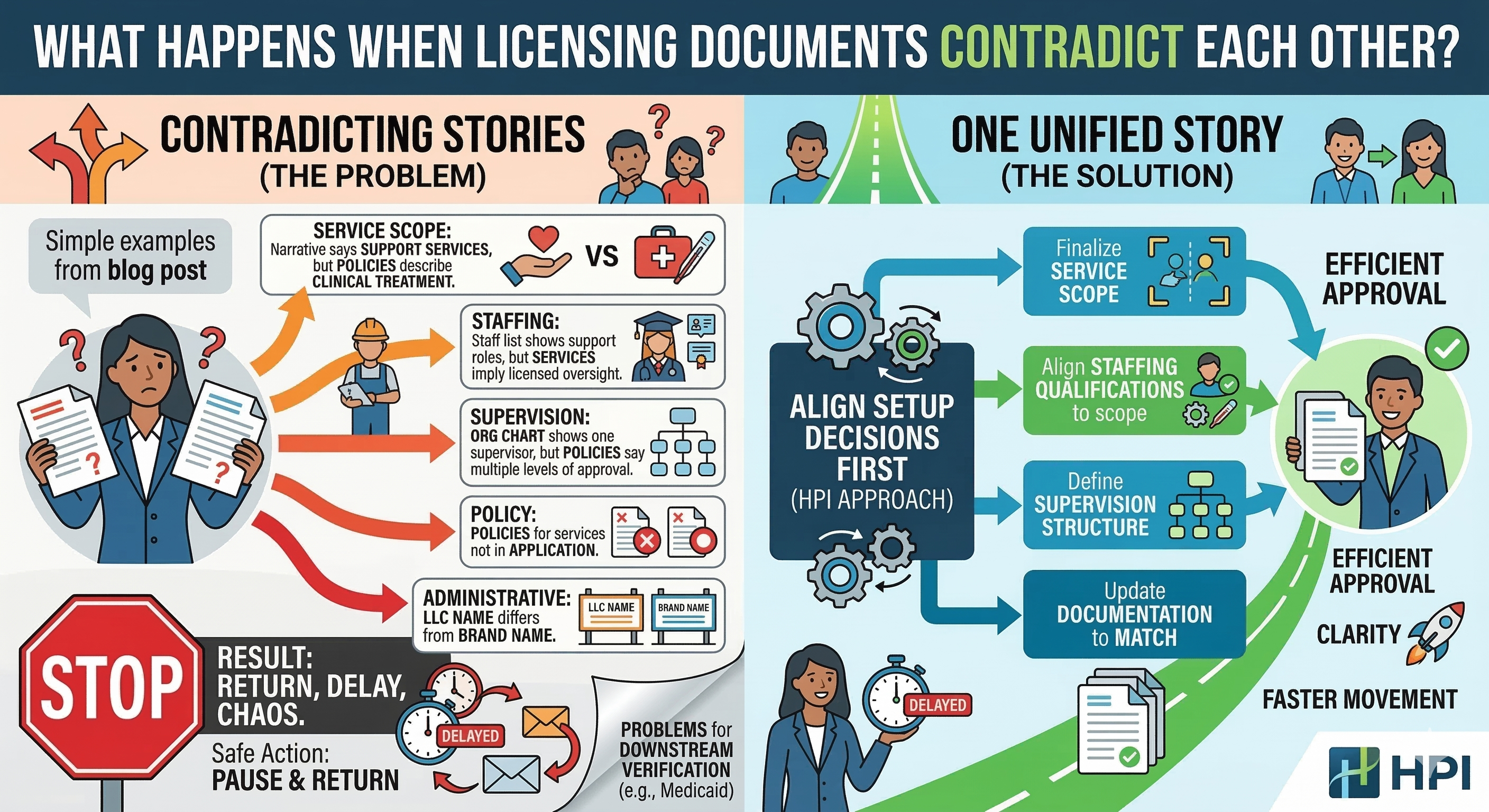
When licensing documents contradict each other, your application submission usually slows down—or gets returned or delayed. Not because the reviewer is being picky. Because contradictions make it impossible to confirm your agency’s setup decisions: Service scope (what you will and will not provide) Staffing qualifications Supervision structure Required documentation that supports the services you listed If the file tells two different stories, the reviewer can’t approve either one. Why contradictions matter more than people think Founders often see contradictions as “small wording issues.” Reviewers see them as setup uncertainty. A reviewer’s job is to approve what they can verify from the application submission. If they have to guess which version is true, the safest action is to pause and request corrections—or return the application. This is especially true when Medicaid enrollment is part of your plan. Medicaid programs must verify that providers who claim to be licensed are licensed, and that licenses are current and unrestricted. If your documents don’t match, you create problems for downstream verification and enrollment decisions.
Common contradictions that slow approval (simple examples) 1) Service scope contradictions What it looks like The application narrative says you provide “support services,” but your policies describe clinical treatment. One section says “no transportation,” another includes transportation procedures. You say “limited hours,” but a policy describes 24/7 coverage. How reviewers respond They stop and ask: “Which one is correct?” They may return the application until the service scope is consistent. 2) Staffing contradictions What it looks like Your staffing list shows support staff only, but your service scope implies licensed oversight. Your job titles and job descriptions don’t match (e.g., “Supervisor” title, but duties read like scheduling). Your policies assign tasks to roles you don’t have. How reviewers respond They can’t confirm staffing qualifications match the services. They pause review until staffing roles and documentation align. 3) Supervision structure contradictions What it looks like Your org chart shows one supervisor, but policies describe multiple levels of approval. Your narrative says “weekly supervision,” but no policy explains who supervises or how it happens. You describe oversight in one place, but leave it out elsewhere. How reviewers respond They can’t confirm accountability. They request revisions because supervision structure must be clear and consistent.
4) Policy contradictions What it looks like Policies describe services you are not applying to provide. Policies include procedures that don’t match your staffing model. Policies reference a program model that doesn’t match your license type. How reviewers respond They treat it as a setup decision problem, not a formatting issue. In licensing frameworks where written policies and procedures are explicitly required, mismatch becomes an immediate reason to stop and request corrections. 5) “Administrative” contradictions that still trigger returns What it looks like Inconsistent agency name across documents (LLC name vs brand name vs abbreviations) Missing or nonconforming submission format Parts of the application are typed and others aren’t, or forms are completed in a way the application instructions reject How reviewers respond They return the application because it does not meet submission requirements. For example, Maryland’s RSA application states handwritten applications are not accepted and will be returned. What reviewers do when they find contradictions In real life, reviewers usually take one of these actions: Request clarification or revisions (you lose time going back and forth) Return the application because it is not reviewable as submitted Pause the approval timeline until a consistent package is submitted The key point: contradictions don’t just create “a comment.” They break the reviewer’s ability to approve the application submission. The reassuring part: contradictions are fixable.
TContradicting documents usually happen for normal reasons—templates, last-minute edits, multiple people writing different sections, or changing plans mid-application. Fixing it is not about “writing better.” It’s about aligning setup decisions first: Finalize the service scope (what you will and will not provide) Align staffing qualifications to that scope Define a clear supervision structure Update required documentation so it matches the final model When the story is consistent, applications move faster. Where HPI comes in (pre-application) This is a classic pre-application problem: you’re building the application submission while the setup decisions are still moving. HPI supports agencies by tightening alignment before submission so your: service scope is consistent across the package staffing qualifications match the services described supervision structure is clear and realistic required documentation supports the exact service model you’re applying for That reduces the return-revise-resubmit cycle.
References
- Maryland OHCQ — Application for a Residential Service Agency License (notes that handwritten applications are returned; outlines submission expectations): https://health.maryland.gov/ohcq/Documents/Providers/RSA/Forms/Application-for-Residential-Service-Agency-License.pdf
- Md. Code Regs. 10.22.02.10 — Policies and Procedures (DDA providers must develop and adopt written policies and procedures): https://www.law.cornell.edu/regulations/maryland/COMAR-10-22-02-10
- 42 CFR § 455.412 — Verification of Provider Licenses (Medicaid agencies must verify licensure and license status): https://www.ecfr.gov/current/title-42/chapter-IV/subchapter-C/part-455/subpart-E/section-455.412