
Welcome to Health Policy Institute
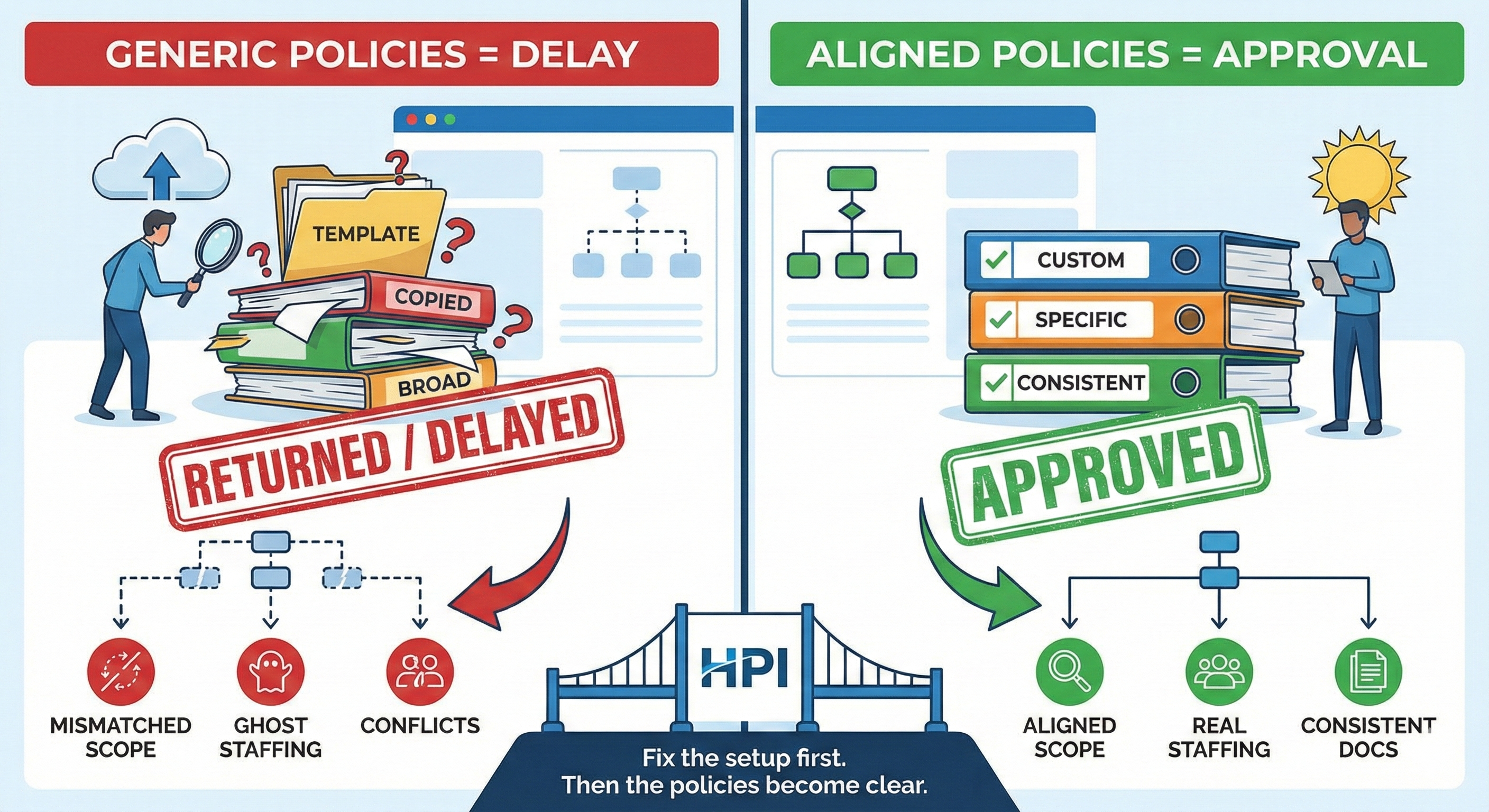
Generic policies delay license approval because licensing reviewers don’t read policies as “paperwork.” They read them as proof that your agency is set up to deliver your service scope with the right staffing qualifications, supervision structure, and required documentation. When policies look copied, broad, or mismatched, reviewers slow down because they can’t confirm what your agency will actually do. This is not a character judgment. It’s a setup problem—and it’s common. Why founders use generic policy templates Most startups use templates for a practical reason: speed. You’re trying to submit the application submission quickly, so you buy policies or copy another agency’s binder and “edit it.” The issue is not using a template. The issue is when the policies do not match your setup decisions. How reviewers actually use policies Reviewers compare your policies to the rest of your application submission. They are looking for consistency between: Service scope (what you will and will not provide) Staffing qualifications (who is qualified to deliver the service) Supervision structure (who oversees services and how) Required documentation (what records you keep and how)
"If your policies don’t match these items, reviewers pause. In many cases, that leads to a returned or delayed application.”The most common “generic policy” problems that trigger delays 1) The policy describes services you are not applying to provide What it looks like: Your policies include sections for services you don’t offer—like skilled nursing, medication administration, clinical treatment services, or restraint procedures—when your service scope doesn’t include those. Why it delays approval: Reviewers now have to ask: “So what are you actually providing?” That creates confusion and forces clarification before approval. 2) The policy assumes staff roles you don’t have What it looks like: The policy says “Clinical Director approves treatment plans,” but your staffing model doesn’t include a Clinical Director. Or the policy assigns tasks to a role that doesn’t exist in your supervision structure. Why it delays approval: Policies are supposed to show how your agency will operate. If your policy relies on staff you don’t have, the reviewer sees a setup mismatch. 3) The policy is too broad to prove anything What it looks like: Statements like: “Staff will be trained as required.” “The agency will ensure proper supervision.” “Documentation will be maintained.” Why it delays approval: A reviewer can’t evaluate “will ensure.” They need to see a clear connection between the service scope and how your agency will run that service with your staffing model. .
Broad language makes your required documentation look unfinished. 4) The policy uses the wrong service language for your license type What it looks like: Your policy language sounds like a completely different provider type (for example, policies written like a behavioral health clinic when you’re applying for a non-clinical support model, or policies written like home care when you’re applying for developmental disability supports). Why it delays approval: It signals that the setup decisions were not made first. Reviewers then question whether the license pathway you chose matches your service scope. 5) The policy conflicts with your application in small but obvious ways What it looks like: Your service scope says “no transportation,” but the policy includes transportation procedures. Your staffing model shows no overnight staff, but the policy describes 24/7 coverage. Your service scope says “no medication support,” but the policy includes medication handling steps. Why it delays approval: These conflicts make reviewers stop reading “fast.” They slow down to reconcile the contradictions—or send it back for revision. The real issue: generic policies create “setup uncertainty” When policies are generic, reviewers can’t confidently answer: “Is this agency set up to deliver what it claims?” If they can’t answer that, the application submission often gets returned or delayed because the agency’s setup decisions are not clear.
What “good policies” look like for licensing Not long. Not fancy. Just aligned. Good policies for licensing usually have these traits: They match your service scope exactly (and do not include extra services) They reflect your real staffing qualifications and supervision structure They clearly match the required documentation you say you will maintain They feel like they were written for your agency, not copied from a different model This is what makes the file easier to review—and easier to approve. Where HPI comes in (pre-application) HPI helps agencies before application submission by preventing the most common policy-related delays. Specifically, HPI supports setup alignment so your policies match: the correct licensing / accreditation pathway the final service scope (what you will and will not provide) the staffing model, staffing qualifications, and supervision structure the required documentation your pathway expects That’s how you avoid submitting a policy binder that creates more questions than answers.
Bottom line Generic policies delay approvals because they create mismatch—between services, staffing, supervision, and required documentation. Most returned or delayed applications are not caused by “bad paperwork.” They’re caused by setup decisions that weren’t finalized before the policies were assembled. Fix the setup first. Then the policies become clear, and the application moves.
References References
- COMAR 10.22.02.10 – Example of required “policies and procedures” expectation in a regulated provider framework:
https://www.law.cornell.edu/regulations/maryland/COMAR-10-22-02-10- Maryland Behavioral Health Regulations Hub – Shows how program type drives requirements, including accreditation-linked pathways in some cases:
https://health.maryland.gov/regs/Pages/10-63-01-10-63-06-Behavioral-Health-Regulations-%28.aspx- Maryland RSA Overview – Illustrates how service scope ties to a specific licensing pathway:
https://health.maryland.gov/ohcq/Pages/Residential-Service-Agencies.aspx