
Welcome to Health Policy Institute
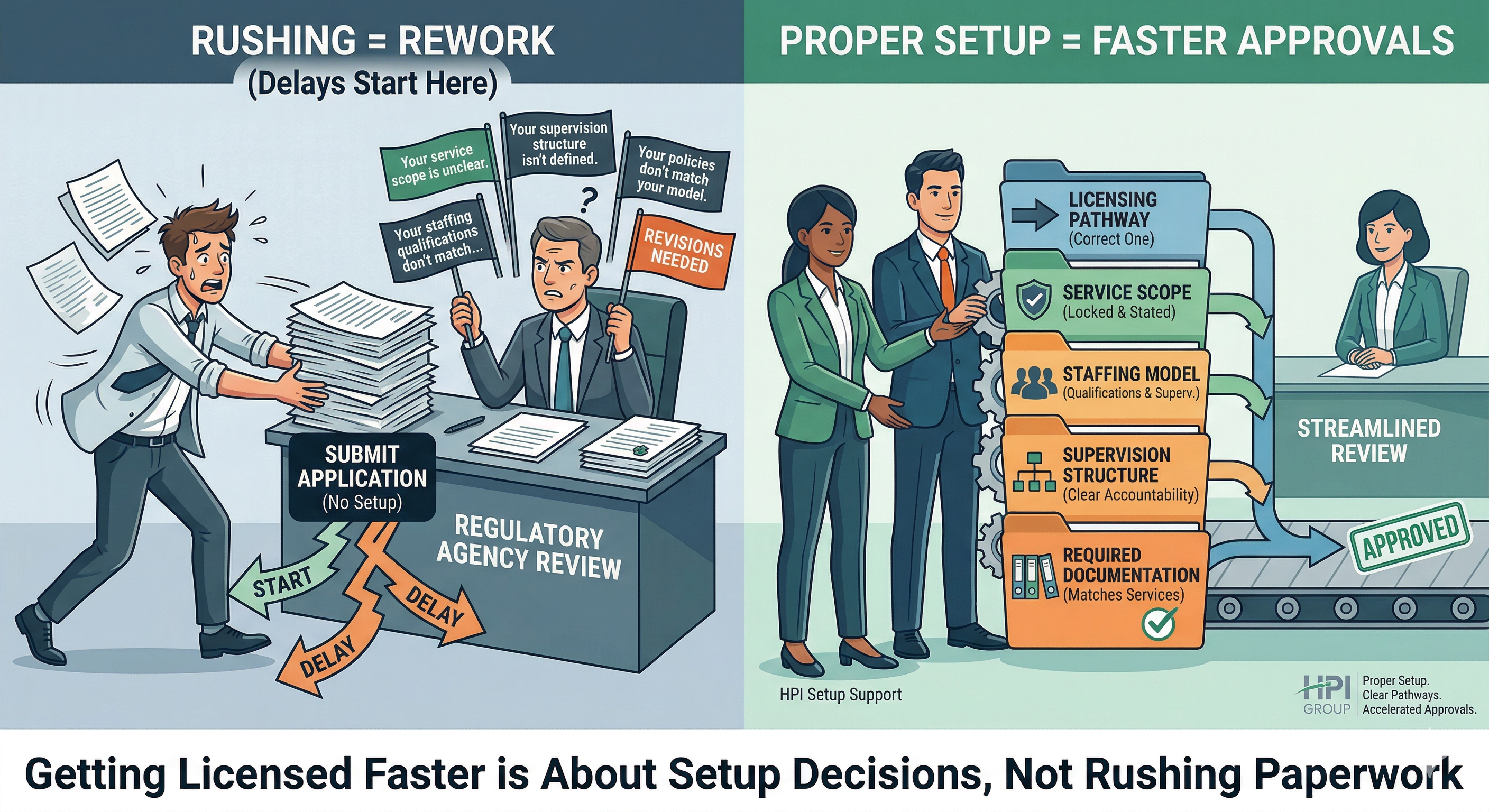
A founder once told me, “We’re going to submit tonight. If we move fast enough, we’ll get approved fast.” Two weeks later, they were still stuck—because the application submission got kicked back with questions that had nothing to do with speed: “Your service scope is unclear.” “Your staffing qualifications don’t match the services described.” “Your supervision structure isn’t defined.” “Your policies don’t match your model.” That’s the truth most people learn the hard way:
The fastest licensing approvals come from proper setup decisions—not rushing the paperwork. Why “rushing” usually slows licensing down Rushing creates one predictable outcome: rework. When you rush, you submit before your agency setup is stable. Then the reviewer has to stop and ask: “Is this agency actually set up to deliver what it says it will do?” If the answer isn’t clear, the file gets returned or delayed. What “proper setup” means in plain language Proper setup means your application submission tells one consistent story across five areas:
Licensing / Accreditation pathway (the correct one for your services) Service scope (what you will and will not provide) Staffing qualifications (who is qualified to deliver services) Supervision structure (who supervises, how oversight works) Required documentation (policies and forms that match the above) When those match, reviewers can review faster because there are fewer questions. The 6 setup moves that make approvals faster (without rushing) These are not step-by-step instructions. They are the decisions that remove delays. 1) Lock your service scope before you touch the application If your service scope is still “in progress,” everything else will be in progress too. Founder example: “We’re an RSA… but we also want to do behavioral health… and maybe Autism Waiver.” That’s not one service scope. That’s three different paths. What to do instead: Pick what you will deliver first, and clearly state what you will not provide yet.
2) Choose the license pathway that fits your service scope (not your business name) Your business name can say anything. The license pathway is decided by services. Founder example: “We’re called ‘Wellness & Recovery’ but we’re actually providing non-clinical support.” If the license pathway doesn’t match the service scope, you’ll get delayed. 3) Build a staffing model that proves you can deliver the services Reviewers are looking for alignment: Service scope → staffing qualifications → supervision structure Founder example: “Our service scope requires licensed oversight, but we’ll hire later.” That usually slows review because the model isn’t supported yet. 4) Write your supervision structure like it’s real (because it must be) A supervision structure is not “we supervise staff.” It’s accountability. Founder example: “One person supervises everything.” That can look unrealistic if your service scope is broad. If the reviewer can’t see clear supervision, the file slows down. 5) Make policies match your actual services (not a template binder) Generic policies create delays because they introduce contradictions. Founder example: “Policies mention a Clinical Director, but we don’t have one.” Or: “Policies include services we aren’t offering.” Reviewers compare your policies to your service scope and staffing. When they don’t match, the reviewer has to stop.
6) Submit one package that tells one story The quickest way to slow licensing is contradictory documents. Founder example: One section says “no medication support,” but a policy includes medication handling Staffing plan shows no overnight staff, but policies describe 24/7 coverage The business name appears in different formats These contradictions create reviewer questions, and questions create delays. What “faster” looks like in the real world Getting licensed faster without rushing usually means: fewer revisions fewer clarification requests fewer returned applications a cleaner approval timeline You’re not speeding up the regulator. You’re removing the reasons they have to pause.
Where HPI comes in (setup only) This is exactly what HPI does before application submission: reduce delay by tightening setup. HPI supports agencies by aligning: the correct licensing / accreditation pathway to your service scope staffing qualifications and supervision structure to the services required documentation to what you will actually provide the full application submission package so it reads consistent and reviewable That is how you move faster without rushing. Bottom line If you want to get licensed faster, don’t rush the application. Rushing produces rework. Proper setup produces approvals. When your service scope, staffing qualifications, supervision structure, and required documentation align to the right licensing pathway, licensing moves as fast as it realistically can.
References References
- Maryland OHCQ — Application for a Residential Service Agency License
(Shows how incomplete/nonconforming submissions can be returned; application completeness language)
View Document- COMAR 10.22.02.10 — Policies and Procedures
(Example of required documentation expectations; misaligned policies trigger review questions)
View Regulation