
Welcome to Health Policy Institute
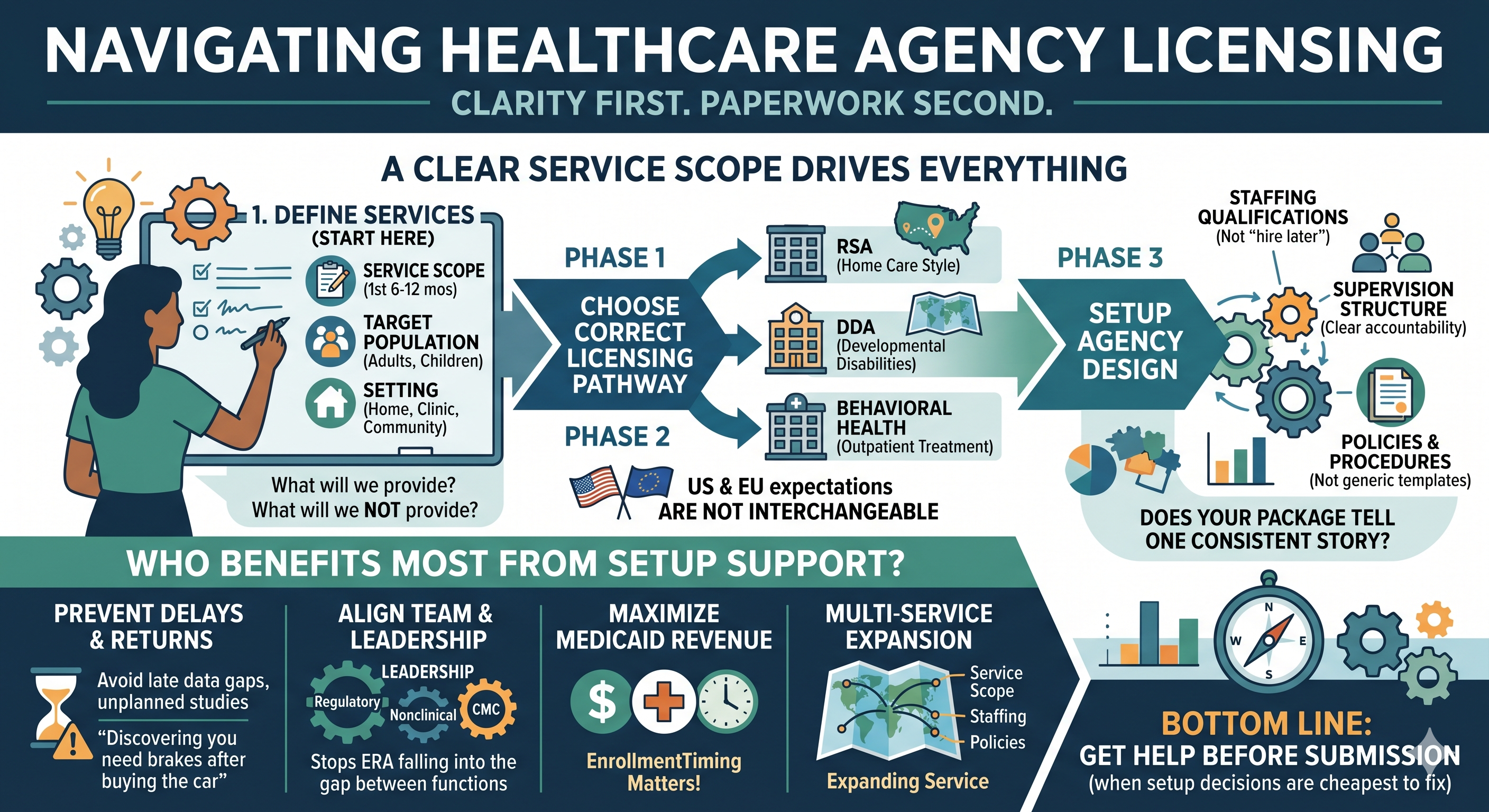
A founder told me, “I don’t need help. I just need time to finish the forms.” A month later, the application submission came back returned—because the issue wasn’t time. It was setup. Licensing help is most useful for people who don’t just need paperwork done, but need their service scope, staffing qualifications, supervision structure, and required documentation to match the correct licensing / accreditation pathway before they submit. If that match is unclear, you’re the type of founder who benefits most from setup support. Who benefits most from licensing setup support (and why) 1) First-time founders Why it helps: First-time founders usually don’t know which parts of the application reviewers treat as “deal breakers.” Common founder pattern: • service scope is broad and changing • staffing is planned as “we’ll hire later” • policies are generic templates • supervision structure is implied, not written Those gaps don’t always look serious to the founder—but they slow approval fast.
2) Clinicians starting an agency for the first time Why it helps: Clinicians are strong at care delivery, but licensing is agency design. Licensing requires clear decisions about: • what services the agency will and will not provide (service scope) • what staffing qualifications are needed to support those services • who supervises the work (supervision structure) • what required documentation proves the agency can operate Clinicians often describe services like clinical practice, which can accidentally place them in the wrong license pathway. 3) Agencies trying to offer more than one service line Why it helps: The more services you offer, the more licensing pathways you might touch. Examples founders recognize: • RSA + DDA • Behavioral Health + Autism Waiver • DDA + Medicaid-funded services across different provider types In multi-service setups, it’s easy for documents to contradict each other (service scope vs staffing vs policies). Contradictions are a common reason applications are returned or delayed. 4) Anyone who isn’t sure they picked the right license type Why it helps: If you’re still deciding between RSA vs DDA vs Behavioral Health (or another pathway), you’re not ready to submit. A wrong license choice doesn’t just delay approval. It forces rework: • rewrite the service scope • rebuild staffing qualifications and supervision structure • redo policies and required documentation • reset parts of the timeline Setup support is most valuable before you lock into the wrong direction.
5) Founders using generic policies or “template binders” Why it helps: Templates are fine. Mismatch is not. If your policies: • mention services you aren’t applying to provide • assign duties to staff roles you don’t have • read like a different type of agency reviewers treat that as a setup problem, not a formatting issue. Some provider frameworks explicitly require written policies and procedures, which makes alignment even more important. (Example: Maryland DDA providers.) (law.cornell.edu) 6) Agencies that need Medicaid revenue to survive the first year Why it helps: Medicaid planning should start during licensing, not after. Federal rules require State Medicaid agencies to verify provider licenses where applicable. If your license type, service scope, or provider identity is unclear, Medicaid enrollment can slow down too. (ecfr.gov) If cash flow depends on Medicaid, setup mistakes are expensive. 7) Agencies expanding services (and trying to avoid changing licenses later) Why it helps: Expansion requires setup updates, even if your license stays the same. Adding services often forces changes in: • service scope • staffing qualifications • supervision structure • required documentation Setup support helps you expand without creating contradictions that trigger delays.
Who may not need much help Some founders don’t need much setup support if they already have: • a clear, narrow service scope • a proven staffing plan with the right qualifications • a clear supervision structure • policies written specifically for the services being offered • a clean, consistent application submission package If your agency setup is already stable and aligned, your main work is just submission and response time. A quick self-check: do you likely benefit from setup support? If you answer “yes” to two or more, setup support is usually worth it: • I’m unsure which license type fits my services • My service scope is still changing • I’m using generic policy templates I haven’t fully aligned • I haven’t clearly defined supervision structure • Staffing qualifications for my service scope are not fully clear • Medicaid enrollment timing matters for my revenue plan
Bottom line The people who benefit most from licensing help are the ones at risk of returned or delayed applications due to setup uncertainty. If you want to protect your approval timeline, the right time to get help is before submission—when setup decisions are still cheap to fix.References
- COMAR 10.22.02.10 — Policies and Procedures (example of explicit written policy requirements for DDA providers): https://www.law.cornell.edu/regulations/maryland/COMAR-10-22-02-10
- 42 CFR § 455.412 — Verification of Provider Licenses (Medicaid enrollment depends on verified licensure where applicable): https://www.ecfr.gov/current/title-42/chapter-IV/subchapter-C/part-455/subpart-E/section-455.412
- Maryland OHCQ — Application for a Residential Service Agency License (example of required attachments and completeness expectations): https://health.maryland.gov/ohcq/Documents/Providers/RSA/Forms/Application-for-Residential-Service-Agency-License.pdf