
Welcome to Health Policy Institute
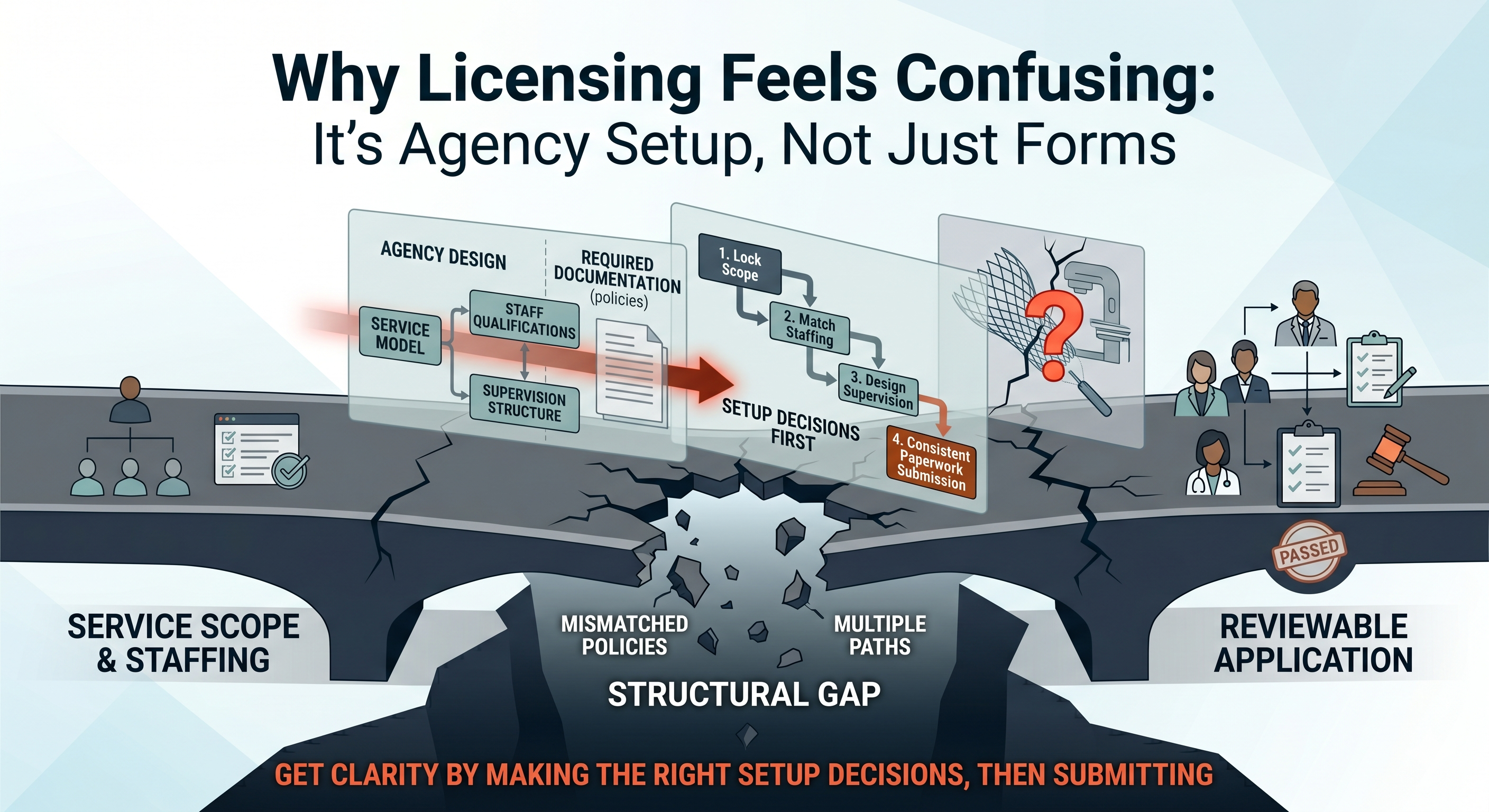
A founder told me, “I’ve started businesses before. This is the first time I feel like I’m guessing.” That’s normal. Healthcare licensing feels confusing because it’s not just an application submission. It’s a test of whether your agency is set up correctly for a specific service model—before you ever see a client. And most of the real requirements are not obvious from the forms. Licensing is confusing because it’s really about setup decisions Most founders assume licensing works like this: Fill out forms → upload documents → wait for approval. But reviewers are really asking: • What is your service scope (what you will and will not provide)? • Do your staffing qualifications match that scope? • Is your supervision structure clear and realistic? • Do your policies and other required documentation match how you’ll operate? • Does your package tell one consistent story? If any of those pieces don’t align, the file slows down or gets returned or delayed. That’s why it feels confusing: you’re doing paperwork, but the reviewer is evaluating agency design.
"”The three biggest reasons founders feel lost 1) The license categories don’t match how founders talk Founders describe services in real-world terms: “support,” “care coordination,” “therapy,” “home visits.” Licensing categories are built around defined provider types and rules. When your service scope doesn’t cleanly fit the category you selected, you start getting conflicting answers from different people. That confusion usually goes away when you tighten your service scope and match it to the correct pathway. 2) Templates make it feel easier—until they cause delays Most agencies use policy templates. That’s not the problem. The problem is mismatch. When generic policies don’t match your services, staffing qualifications, or supervision structure, the reviewer can’t confirm how your agency will operate. In some provider frameworks, written policies and procedures are explicitly required, so mismatch becomes an immediate reason to pause. (law.cornell.edu) This is why founders feel like they’re “doing everything right” but still getting delayed.
3) Multiple agencies may be involved Some agencies need more than one approval path—especially when Medicaid, DDA, and Autism Waiver are involved. That can feel like moving targets because each system is responsible for a different layer: • licensing authority (permission to operate) • program requirements (how services must be structured) • payer enrollment (how you get paid) If you treat these layers as one task, it feels chaotic. If you plan them as connected layers, it becomes clearer.
How clarity happens: you make the setup decisions first Licensing becomes less confusing when you stop trying to “figure it out inside the application” and instead lock the setup first. Clarity usually comes from four decisions: 1) A clear service scope What you will provide now. What you will not provide yet. One clean story. 2) Staffing qualifications that match the services Not “we’ll hire later,” but a realistic staffing model that supports the scope. 3) A supervision structure that makes sense Clear accountability. Clear oversight. No guessing who supervises what. 4) Policies that match your model Not generic. Not forced. Written for the agency you are actually building. When those decisions are stable, the paperwork becomes easier because you’re not rewriting the agency while you submit.
A simple sign you’re on the right track Licensing stops feeling confusing when you can answer these questions without changing your answer every week: • What exactly are we providing (service scope)? • Who is qualified to do it (staffing qualifications)? • Who supervises and how (supervision structure)? • Do our policies match those answers (required documentation)? If those answers are clear, your application submission becomes reviewable—and delays drop.
Where HPI comes in (setup only) This is the stage where setup support is most useful: before submission, when confusion is highest and mistakes are cheapest to fix. HPI helps create clarity by aligning: • the correct licensing / accreditation pathway to your service scope • staffing qualifications and supervision structure to the services • policies and required documentation to the real operating model • the submission package so it tells one consistent story That’s how licensing stops feeling like guessing. Bottom line Licensing feels confusing because it looks like paperwork, but it’s really agency setup. You don’t get clarity by filling out more forms. You get clarity by making the right setup decisions first—service scope, staffing qualifications, supervision structure, and required documentation—then submitting one consistent package.
References
- COMAR 10.22.02.10 — Policies and Procedures (example of explicit written policy requirements that make policy mismatch a common delay point): https://www.law.cornell.edu/regulations/maryland/COMAR-10-22-02-10
- Maryland OHCQ — Residential Service Agencies Overview (example of licensing tied to service scope): https://health.maryland.gov/ohcq/Pages/Residential-Service-Agencies.aspx
- Maryland Behavioral Health Regulations Hub (COMAR 10.63 Framework) (illustrates program-type licensing structure): https://health.maryland.gov/regs/Pages/10-63-01-10-63-06-Behavioral-Health-Regulations-%28.aspx