
Welcome to Health Policy Institute
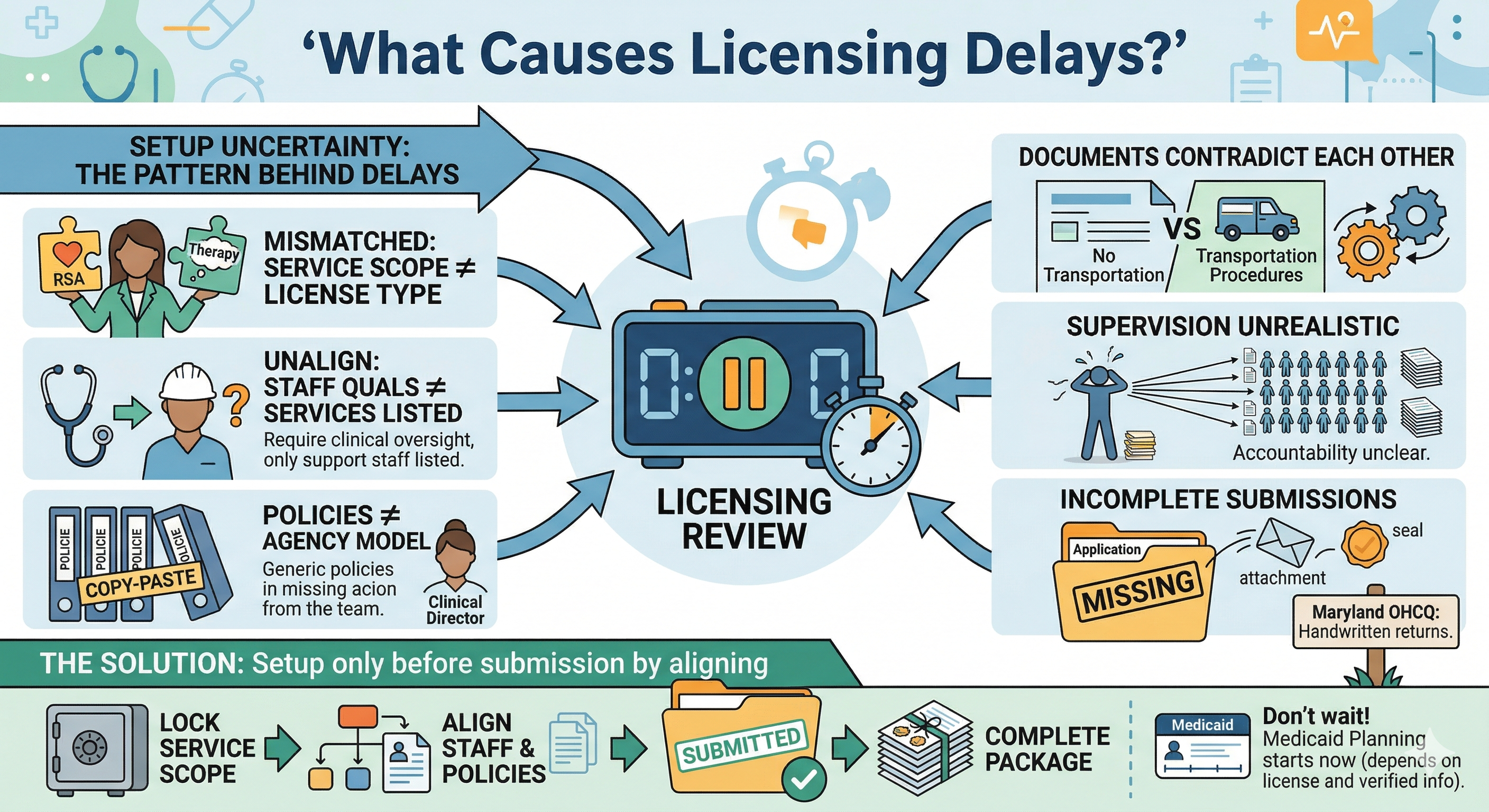
A founder once told me, “We submitted everything. Why is it still not moving?” When we looked at the application submission, nothing was “missing” in the obvious way. The real issue was quieter: The service scope in one section didn’t match the staffing qualifications in another. The supervision structure was vague. The policies sounded like a different type of agency. To a reviewer, that’s not a small issue. It’s a sign the agency setup decisions are still moving. And when setup decisions are unclear, licensing slows down. The biggest causes of healthcare licensing delays (plain English) Licensing delays usually come from setup, not effort. Below are the causes founders run into most often, with examples you’ll recognize.
1) The service scope doesn’t match the license type What it means: You applied under one pathway, but your services read like another. Founder example: “I’m applying as RSA, but I also want to offer therapy.” Or: “I’m doing DDA, but our services sound like home care.” Why it delays: Reviewers can’t approve a license pathway when the service scope doesn’t fit the category. That often triggers a returned or delayed application. 2) Your service scope is too broad or keeps changing What it means: Your application describes “everything we might do,” not what you will actually do. Founder example: “We want to provide supportive services, clinical services, transportation, and day services… and we’ll figure out staffing later.” Why it delays: A broad service scope forces the reviewer to evaluate multiple sets of staffing qualifications and documentation expectations. If you’re not clearly set up for that full scope, review slows down fast. 3) Staffing qualifications don’t support the services listed What it means: Your service scope implies certain credentials, but your staffing model doesn’t show them. Founder example: “Our services require clinical oversight, but we only listed support staff.” Or: “We’ll hire the licensed supervisor after approval.” Why it delays: Reviewers evaluate what is supported in the application submission—not what you plan to hire later.
4) Supervision structure is unclear or unrealistic What it means: The reviewer can’t tell who supervises whom, or the supervision structure doesn’t make sense for the services. Founder example: “One person supervises all staff, all services, and all documentation.” Or: “Supervision happens as needed.” Why it delays: If accountability is unclear, the reviewer pauses. Supervision structure is part of proving the agency can operate as described. 5) Policies don’t match the agency you’re applying to run What it means: Policies were copied or generic, and they don’t match your service scope and staffing. Founder example: “Our policies mention a Clinical Director, but we don’t have one.” Or: “Policies include services we aren’t offering.” Why it delays: Reviewers compare policies to the service scope and staffing model. When they don’t match, it signals unstable setup decisions, and the file slows down. 6) Documents contradict each other What it means: Two parts of the application tell two different stories. Founder example: Service scope says “no transportation,” but the policy includes transportation procedures Staffing plan shows no overnight staff, but policies describe 24/7 coverage One form lists one business name, another uses a different version
Why it delays: Contradictions force the reviewer to stop and request corrections. They can’t approve a file they can’t verify. 7) Missing attachments and “almost complete” submissions What it means: You submitted most of the package, but one required piece is missing or not in the requested format. Founder example: “We thought we could submit the main application now and add the rest later.” Why it delays: Many licensing offices treat incomplete submissions as not reviewable. For example, Maryland’s RSA application states handwritten submissions are not accepted and will be returned, and it explains the application is not complete until required materials are received. (health.maryland.gov ) 8) Medicaid planning starts too late What it means: You treat Medicaid enrollment like a post-licensing task. Founder example: “We’ll do Medicaid after we get the license.”
Why it delays revenue: Medicaid enrollment depends on verified provider details and, where applicable, verified licensing status. Federal rules require state Medicaid agencies to verify provider licenses. (ecfr.gov ) If licensing gets delayed or your setup changes, Medicaid enrollment can slip too. The pattern behind most delays Most delays are caused by one thing: setup uncertainty. When your service scope, staffing qualifications, supervision structure, and required documentation do not align, reviewers can’t approve the file as written. The reassuring part: delays are preventable You don’t need a perfect application. You need a consistent one. Licensing moves faster when you: lock the service scope (what you will and will not provide) choose the correct license pathway for that scope align staffing qualifications and supervision structure align policies and required documentation to the real model submit one package that tells one story Where HPI comes in (setup only) HPI helps agencies before submission by tightening setup decisions so the application doesn’t stall. That includes: matching licensing / accreditation pathway to service scope aligning staffing qualifications and supervision structure aligning policies and required documentation reducing contradictions and rework in the application submission package
References
- Maryland OHCQ — Application for a Residential Service Agency License (submission rules; completeness language; handwritten applications returned): https://health.maryland.gov/ohcq/Documents/Providers/RSA/Forms/Application-for-Residential-Service-Agency-License.pdf
- 42 CFR § 455.412 — Medicaid Verification of Provider Licenses (licensing affects Medicaid timelines): https://www.ecfr.gov/current/title-42/chapter-IV/subchapter-C/part-455/subpart-E/section-455.412
- Maryland Medicaid ePREP FAQs (approval timeline depends on complete/accurate application; effective date is approval date): https://health.maryland.gov/mmcp/siteassets/pages/provider-information/eprep%20faqs%202.0%20update%204.23.2018.pdf
- Maryland BHA — Chapter 06 Application and Licensure Process (shows licensing timing expectations like renewal submission window): https://health.maryland.gov/bha/documents/chapter%2006%20application%20and%20licensure%20process.pdf
- COMAR 10.63.06.21 (example of licensing deadlines/effective date language in behavioral health framework): https://www.law.cornell.edu/regulations/maryland/COMAR-10-63-06-21