
Welcome to Health Policy Institute
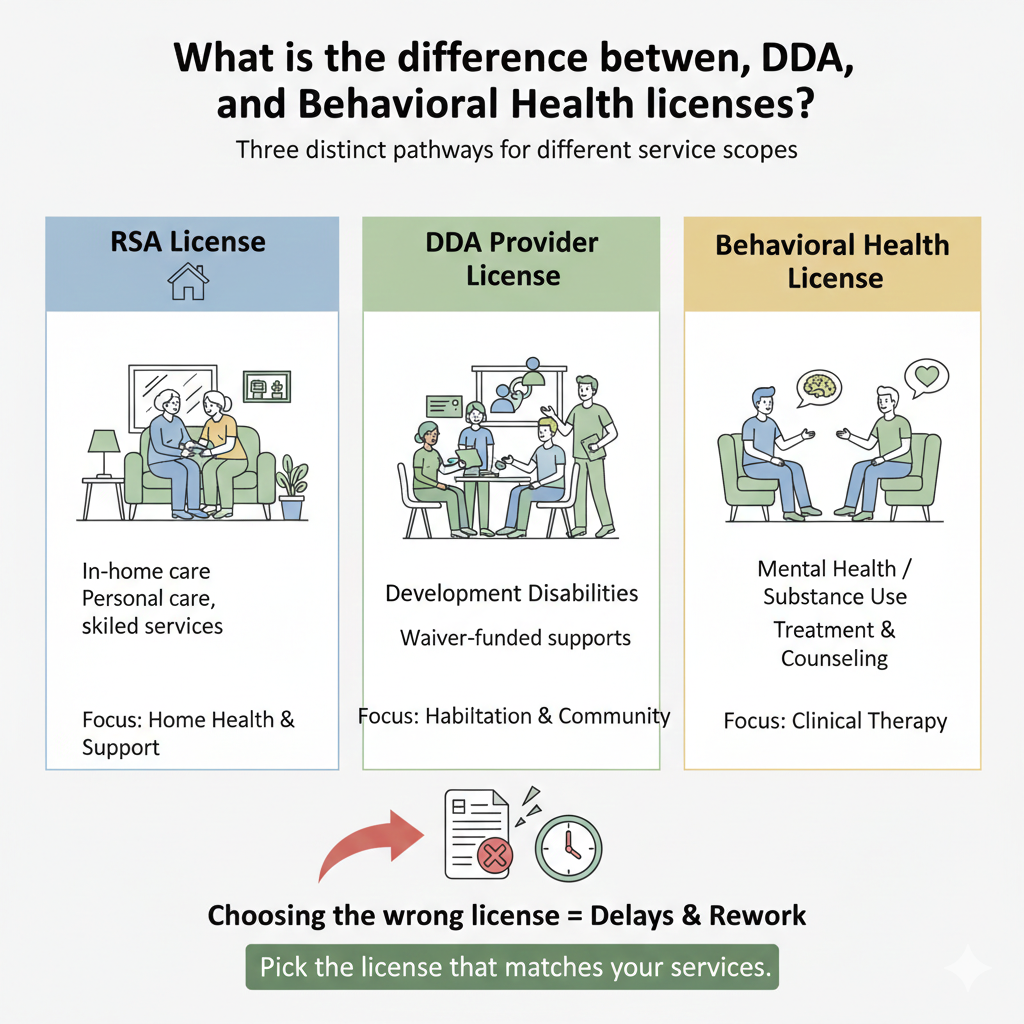
They are not three names for the same thing. An RSA, a DDA provider license, and a Behavioral Health license exist for different service scopes, with different staffing qualifications and supervision structures. If you choose the wrong one, your application submission can be returned or delayed—because the reviewer can’t match what you say you will do to the license pathway you selected. The plain-language difference Think of these as three different “lanes”: RSA: in-home care and home health-type services DDA: services and supports for people with developmental disabilities (often waiver-funded) Behavioral Health: mental health and/or substance use treatment services Each license is meant for a different kind of agency setup. RSA license What it’s meant for An RSA (Residential Service Agency) is for agencies providing home health care services (in the person’s home) for compensation—often including personal care and, depending on the RSA type, skilled services. In Maryland, the state describes an RSA as a business that employs or contracts with individuals to provide at least one home health care service to an unrelated sick or disabled individual. Typical service scope Examples commonly associated with RSA-type agencies include: Assistance with activities of daily living (bathing, grooming, dressing) Nursing services (if the RSA type allows it) Therapy services (in some RSA models) Sometimes related service lines like DME, depending on structure and approvals What reviewers look for in setup A service scope that clearly describes in-home services Staffing qualifications that match your service scope (e.g., aides vs nursing) A supervision structure that matches how staff are deployed in homes In Maryland, RSA licensing is handled by Office of Health Care Quality.
"DDA provider license What it’s meant for:”A DDA license is for agencies providing services and supports to individuals with developmental disabilities under a defined program model (often tied to waiver services and individual planning requirements). In Maryland, Developmental Disabilities Administration points providers to COMAR requirements that apply to DDA providers. Typical service scope DDA provider service scopes often include: Residential and community supports (habilitation-style supports) Day supports and community integration-type services Support services designed around an individual’s plan and service authorization What reviewers look for in setup A service scope clearly written as developmental disability supports, not “home care” Staffing qualifications aligned to that model (support staff, supervisors, program leadership) Required documentation and operational structure that matches the DDA framework (for example, written policies and procedures are explicitly required in the administrative requirements). Behavioral Health license What it’s meant for A Behavioral Health license is for agencies providing community-based behavioral health services (mental health and/or substance use services) under behavioral health regulatory frameworks. In Maryland, Behavioral Health Administration publishes the behavioral health licensing regulatory framework, including identifying programs that must be accredited to receive a license for certain community-based behavioral health services. Typical service scope Behavioral health service scopes often include: Outpatient mental health treatment and counseling Substance use disorder services Higher-intensity behavioral health services depending on the program type .
What reviewers look for in setup A service scope that clearly describes treatment services (not “supportive services”) Staffing qualifications consistent with clinical services (licensed clinicians, clinical oversight) A supervision structure showing how clinical services are supervised and managed Where applicable, alignment with accreditation-required pathways for certain program categories (this is a setup choice that affects your approval timeline). Why choosing the wrong license causes delays and rework When the wrong license is selected, the reviewer usually sees one of these mismatches: 1) Your service scope doesn’t match the license category Example: You apply as an RSA, but your service scope reads like treatment services (behavioral health). Or you apply as behavioral health, but your service scope reads like non-clinical support services. That triggers a pause because the reviewer can’t approve a pathway that doesn’t fit the service scope. 2) Your staffing qualifications don’t match the services you described Example: You describe clinical services but your staffing model is built like a non-clinical support agency. Or you describe DDA-style supports but your staffing plan is written like a home care agency. Now your application submission becomes a redesign project. 3) Your supervision structure doesn’t match your operating model Example: You describe services that require clinical oversight, but your supervision structure is written like an aide-based model. That’s not a minor fix—reviewers treat it as a setup decision problem. 4) Your required documentation doesn’t match what you’re applying to do If your policies read like “someone else’s agency,” reviewers assume the setup decisions are not finalized. In DDA contexts, written policies and procedures are explicitly required, so mismatch becomes an immediate credibility problem. A simple way to think about the right fit Use this “who is it for?” filter: RSA: people needing in-home care services (often personal care and/or skilled home health-type services) DDA: people with developmental disabilities receiving structured supports tied to individual plans and service authorizations Behavioral Health: people receiving mental health and/or substance use treatment services delivered by qualified clinical staff If your agency plans to do more than one of these, that can be valid—but it usually requires separate service scopes, separate staffing models, and clean separation in required documentation so each license pathway reads as coherent. Bottom line Licensing delays usually come from setup decisions, not paperwork mistakes. Pick the license that matches your services, then build the staffing qualifications, supervision structure, and required documentation around that service scope. That’s how you avoid returned or delayed application submissions.
References
- Maryland RSA overview (definition, examples of RSA services, regulator)
- RSA definitions in COMAR (Residential Service Agency definitions)
- Maryland Health Care Commission RSA fact sheet (RSA license types, context)
- Maryland DDA regulations landing page (COMAR applies to DDA providers)
- COMAR 10.22.02 Administrative Requirements for Licensees (DDA provider framework)
- COMAR 10.22.02.10 Policies and Procedures (required documentation expectations)
- Maryland behavioral health regulations hub (COMAR 10.63.01–10.63.06)
- COMAR 10.63.01 PDF (behavioral health licensing definitions and requirements)