
Welcome to Health Policy Institute
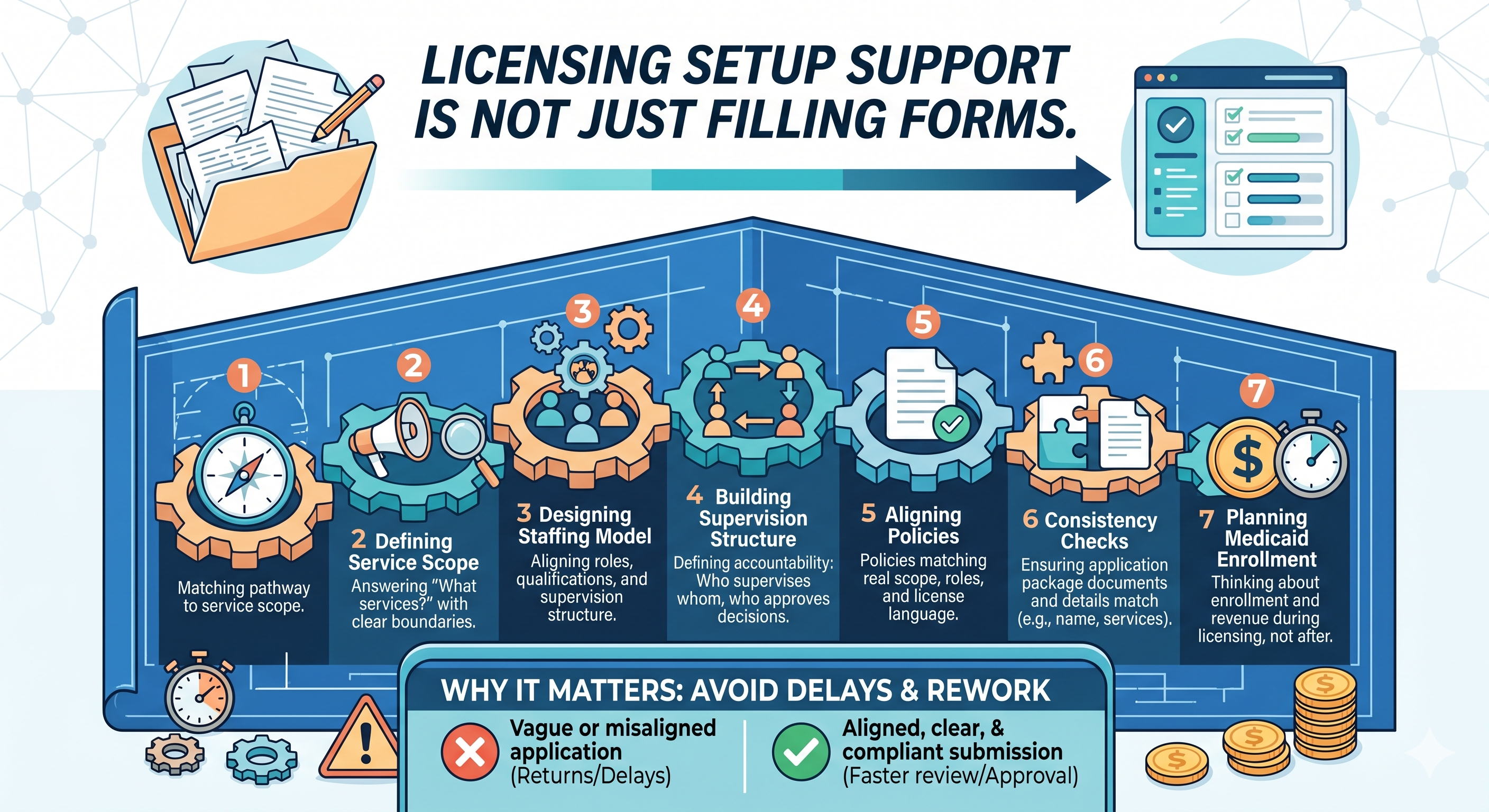
A lot of founders think “licensing help” means someone fills out forms for you. Real licensing setup support is different. It’s the work that happens before application submission—so your application doesn’t get returned or delayed because the agency wasn’t structured clearly. In plain English: licensing setup support helps you make the decisions that reviewers are silently checking. What licensing setup support actually covers 1) Picking the right licensing / accreditation pathway This is the first decision that affects everything else. Setup support helps you match the pathway to your service scope, not your business name or what you “might” do later. Example founders recognize: An agency applies under an RSA pathway, but their services read like behavioral health treatment. That’s not a paperwork mistake. That’s a pathway mismatch.
2) Defining your service scope (with clear boundaries) Setup support helps you write a service scope that answers: • What services will we provide? • What services will we not provide (yet)? • What does “day one” look like? This matters because the service scope drives staffing qualifications, supervision structure, and required documentation. Common problem it prevents: A vague service scope that tries to cover everything—then the reviewer can’t tell what license category fits 3) Designing the staffing model around licensing rules Staffing setup support focuses on alignment, not hiring. It helps clarify: • which roles must exist for the services you’re applying to provide • what staffing qualifications those roles need • what “enough staffing” looks like for the model (without over-hiring) Example founders recognize: You list services that require qualified oversight, but your staffing plan doesn’t show who qualifies to supervise those services
4) Building a clear supervision structure Supervision structure is not an org chart. It’s accountability. Setup support helps define: • who supervises whom • who approves key decisions • how oversight connects to the services you’re providing Common problem it prevents: A supervision structure that looks good on paper but doesn’t match how the agency will actually operate. 5) Aligning policies and required documentation to your real model This is where many applications stall. Setup support helps ensure your policies: • match your service scope exactly • match real staff roles you actually have • use language that fits the license type you’re applying for • don’t include “extra services” you aren’t applying to provide Example founders recognize: Policies mention a “Clinical Director” approving plans, but your staffing model doesn’t include that role. Reviewers treat that as a setup mismatch. Some provider frameworks explicitly require written policies and procedures, which is why generic policies can create delays. (Example: DDA provider policy requirements.)
6) Making the application submission package consistent Reviewers read your application as a whole. Setup support includes consistency checks like: • same business name across documents • service scope doesn’t change from one section to another • staffing qualifications match the services described • policies don’t contradict staffing or services • attachments match what the application asks for Common problem it prevents: “Almost complete” submissions where one gap breaks the whole story
7) Planning Medicaid enrollment early (if Medicaid is part of your revenue plan) Setup support often includes helping you think about Medicaid enrollment during licensing—not after. Why? Because Medicaid enrollment depends on verified provider details and, where applicable, verified licensing status. Federal rules require state Medicaid agencies to verify provider licenses when a provider claims to be licensed. Founder-friendly translation: If licensing is unclear or changes later, Medicaid enrollment and revenue often get delayed too. .
What setup support is NOT To keep expectations realistic, good setup support is usually not: • a promise of a guaranteed timeline • “we’ll just submit and see what happens” • copying a policy binder and swapping your agency name • telling you to hire a full team before approval It’s the opposite: stabilize decisions first so you don’t pay for rework later. Why this matters Most returned or delayed applications don’t happen because someone forgot a signature. They happen because the reviewer can’t confirm alignment between: service scope, staffing qualifications, supervision structure, and required documentation. Licensing setup support exists to prevent that
References (Clickable)
- Maryland RSA Application (shows completeness expectations and what must be submitted): https://health.maryland.gov/ohcq/Documents/Providers/RSA/Forms/Application-for-Residential-Service-Agency-License.pdf
- Maryland RSA Overview (licensing context): https://health.maryland.gov/ohcq/Pages/Residential-Service-Agencies.aspx
- COMAR 10.22.02.10 (DDA providers—policies and procedures requirement): https://www.law.cornell.edu/regulations/maryland/COMAR-10-22-02-10
- 42 CFR § 455.412 (Medicaid must verify provider licenses where applicable): https://www.ecfr.gov/current/title-42/chapter-IV/subchapter-C/part-455/subpart-E/section-455.412