
Welcome to Health Policy Institute
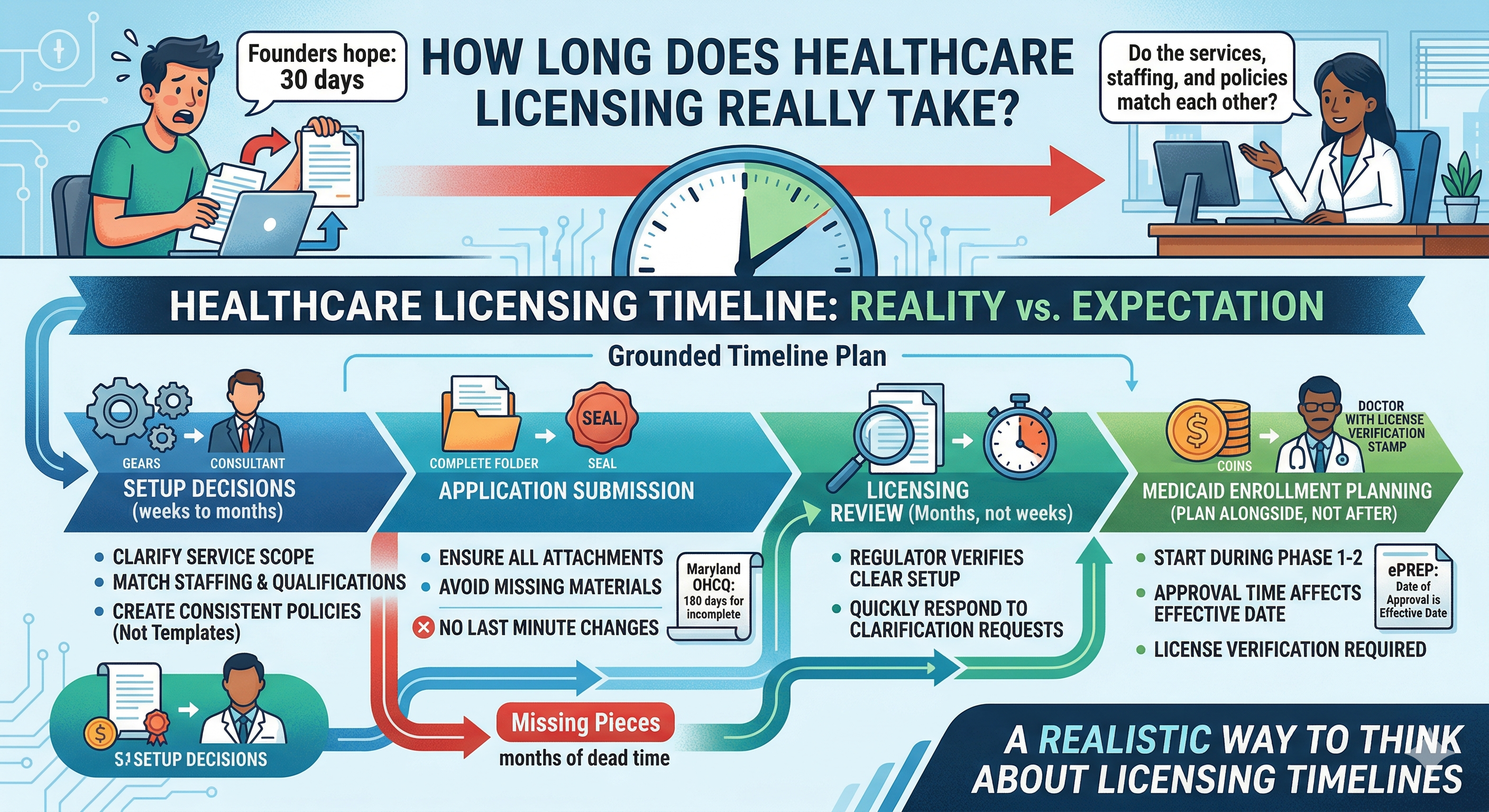
A founder told me, “We’re trying to open in 30 days. We already filled out most of the application.” Two weeks later, the application submission was still sitting—because the reviewer came back with the same quiet question every regulator asks: “Do the services, staffing, supervision structure, and policies match each other?” That’s the part founders don’t plan for. Licensing timelines are not just about how fast you can upload documents. They’re about how fast your agency setup can be clearly verified. A realistic way to think about licensing timelines Most healthcare licensing timelines are measured in months, not weeks—especially for first-time founders. A practical planning view looks like this:
Setup work (before you submit): usually weeks to a few months Regulator review (after submission): depends heavily on whether the package is complete and consistent Medicaid enrollment (if you need it to bill): should be planned alongside licensing, not after, because Medicaid enrollment review depends on verified information and licensing status I’m not going to promise a number, because regulators don’t promise numbers. But I can tell you what usually controls speed. What affects how fast licensing moves 1) Your service scope is clear (or it isn’t) If your service scope clearly states what you will and will not provide, the reviewer can quickly decide whether you chose the right licensing pathway. If your service scope is broad or mixed (support + clinical + waiver services all in one description), the reviewer has to slow down because the license type may not match the services described. 2) Your staffing qualifications match the services you listed Reviewers look for a simple fit: Services described → staff roles needed → qualifications and supervision structure When staffing doesn’t match (for example, services imply licensed oversight but your staffing plan doesn’t show who provides it), the review stops until that mismatch is fixed. 3) Your policies match your service model (not a template binder) Policies are not “extra paperwork.” They are proof your agency can operate as described. If your policies mention services you aren’t providing, or staff roles you don’t have, you create confusion and slow the approval timeline.
4) Your application is actually “complete” Many agencies submit something that feels complete—until the regulator checks required attachments. For example, Maryland’s RSA application explains that the application is not complete until all required materials are received, and that OHCQ will hold an incomplete RSA application for 180 days from initial receipt before it becomes inactive and is administratively closed. That’s a big deal: a missing piece can turn into months of dead time. 5) You make last-minute changes after submission This is one of the most common timeline killers. If you change services, staffing, or leadership roles after you submit, you usually trigger a cascade: update service scope update staffing plan and supervision structure update policies and required documentation resubmit corrections That’s how “we’re almost done” becomes a second (or third) round of review. Where Medicaid fits into the timeline (and why it adds time if you wait) If Medicaid revenue is part of your plan, your timeline is not “license first, Medicaid later.” Medicaid enrollment planning should run during licensing.
Two simple reasons: Effective date reality: Maryland’s ePREP FAQs state that the effective date is the day the application is approved, not the day it’s submitted, and approval time depends largely on submitting a complete and accurate application. License verification: Medicaid programs must verify provider licenses where applicable, which means licensing status and provider details need to be clean and consistent. Translation: if licensing drags, Medicaid revenue usually drags with it. What a grounded timeline plan looks like If you want realistic expectations, plan in phases: Phase 1: Setup decisions (service scope, staffing qualifications, supervision structure, policies) Phase 2: Application submission (complete, consistent, no contradictions) Phase 3: Licensing review (respond quickly if the regulator requests clarification) Phase 4: Medicaid enrollment planning (start during Phase 1–2, not after Phase 3) This approach doesn’t “guarantee speed.” It prevents the slowest thing in licensing: rework. The calm takeaway Healthcare licensing really takes as long as it takes to prove one thing: your agency is set up correctly for the services you’re applying to provide.
The fastest approvals usually come from agencies that: finalize setup decisions before submitting submit a complete package (no missing attachments) keep services, staffing, supervision, and policies aligned from start to finish
References
- Maryland OHCQ — Application for a Residential Service Agency License (incomplete applications held 180 days; completeness requirements): https://health.maryland.gov/ohcq/Documents/Providers/RSA/Forms/Application-for-Residential-Service-Agency-License.pdf
- Maryland Medicaid ePREP FAQs (approval timeline depends on complete/accurate application; effective date is approval date): https://health.maryland.gov/mmcp/siteassets/pages/provider-information/eprep%20faqs%202.0%20update%204.23.2018.pdf
- Maryland BHA — Chapter 06 Application and Licensure Process (shows licensing timing expectations like renewal submission window): https://health.maryland.gov/bha/documents/chapter%2006%20application%20and%20licensure%20process.pdf
- COMAR 10.63.06.21 (example of licensing deadlines/effective date language in behavioral health framework): https://www.law.cornell.edu/regulations/maryland/COMAR-10-63-06-21