
Welcome to Health Policy Institute
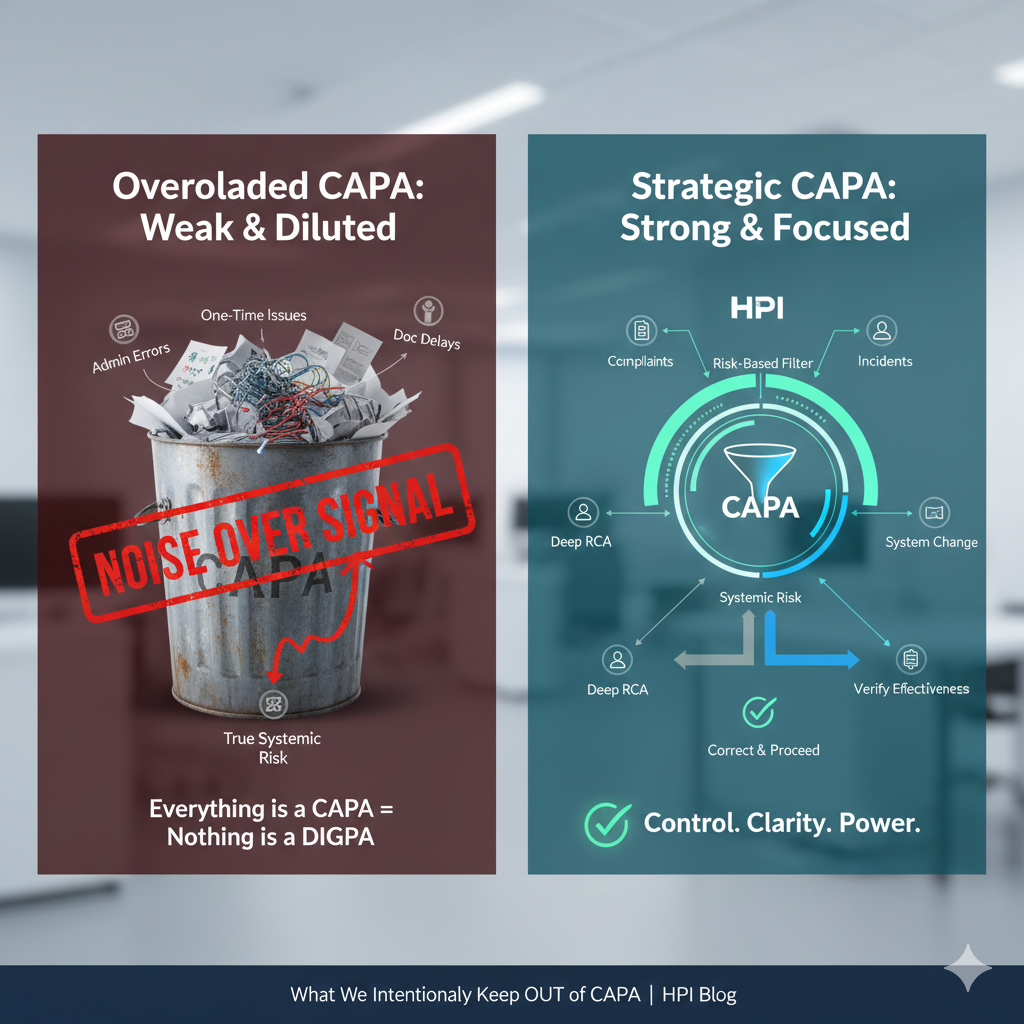
(And Why This Makes CAPA Stronger) Many organizations believe a “strong CAPA system” captures everything. In reality, the strongest CAPA systems are selective by design. At HPI, we help healthcare and regulated organizations build CAPA programs that are rare, deliberate, and powerful—not overloaded, reactive, or diluted. Effective CAPA systems intentionally exclude low-risk, one-time, or already-corrected issues. Overloading CAPA with administrative errors, non-risk documentation delays, or resolved structural issues weakens its ability to detect and correct true systemic risk. CAPA Is Not a Trash Bin for Every Issue CAPA exists to address systemic, recurring, or high-risk failures.
"When every problem—regardless of risk, impact, or recurrence—is escalated into CAPA:"Root cause analysis becomes superficial Teams lose signal clarity Leadership attention is diluted Inspectors see volume, not control HPI designs CAPA systems to filter noise before escalation, not after. 1. One-Time Administrative Errors Correct. Document. Move on. Single-occurrence errors such as: Missed signatures Formatting mistakes Isolated data entry errors do not automatically justify CAPA.
At HPI, we help organizations: Define clear correction pathways Require documentation of resolution Prevent unnecessary escalation CAPA is not required to prove accountability—good procedures are. 2. Documentation Lag With No Patient or Client Risk Fix the workflow, not the system of record. Late documentation without: Safety impact Compliance breach Recurrence pattern is a process efficiency issue, not a CAPA trigger. .
HPI addresses these issues by: Redesigning documentation workflows Clarifying responsibility and timing in SOPs Eliminating friction points that cause delay CAPA is not a time-tracking tool. 3. Issues Already Structurally Corrected CAPA after the fact adds no value. If an issue has already been resolved through: Policy redesign System controls Process restructuring then opening a CAPA retroactively adds paperwork—not prevention. HPI helps teams: Document structural corrections properly Justify non-CAPA decisions using risk-based rationale Defend these decisions during audits and inspections CAPA should drive change, not memorialize it. Why Overloaded CAPA Systems Always Collapse When CAPA is used for everything: True systemic risks get buried Investigations become rushed Actions focus on documentation fixes Effectiveness checks lose meaning Inspectors recognize this immediately. An overloaded CAPA system signals poor risk governance, not diligence.
How HPI Designs CAPA to Stay Strong HPI works with healthcare organizations, staffing agencies, RSA providers, and regulated businesses to design CAPA systems that are: ✔ Risk-Based Only issues with meaningful impact or recurrence qualify. ✔ Defensible Clear justification exists for both CAPA and non-CAPA decisions. ✔ Integrated Upstream processes—complaints, audits, incidents—are designed to filter signals before escalation. ✔ Leadership-Driven CAPA outputs inform management review and strategic decisions. This approach keeps CAPA focused, credible, and inspection-ready. CAPA Should Be Rare, Deliberate, and Powerful A high-volume CAPA system is not a mature system. A selective CAPA system is. When CAPA is reserved for the right issues: Root causes go deeper Actions change behavior Risk actually decreases Inspections become conversations—not confrontations That is the outcome HPI designs for. Final Takeaway CAPA strength comes from what you exclude, not what you collect. If your CAPA system feels heavy, slow, or ineffective, the problem is rarely execution—it’s scope. HPI helps organizations design boundaries that protect CAPA’s purpose and preserve its power. 💬 Comment with your questions—we’re happy to help you evaluate whether your CAPA system is focused or overloaded.