
Welcome to Health Policy Institute
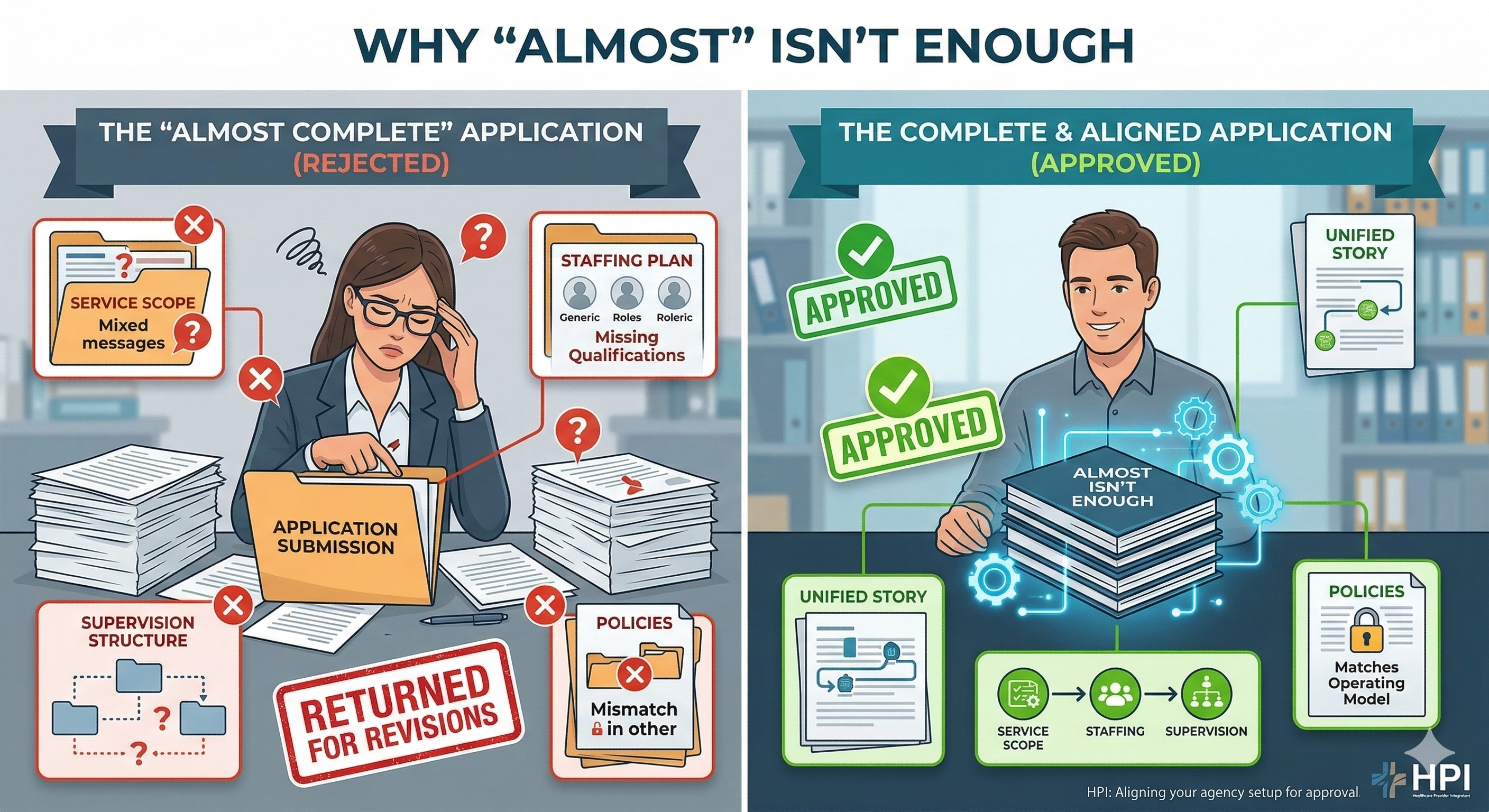
Because licensing reviewers don’t approve “almost.” They approve a complete, consistent agency setup. An “almost complete” application usually has small gaps that seem minor to the applicant, but to a reviewer they create one big problem: The application submission doesn’t fully prove that your service scope, staffing qualifications, supervision structure, and required documentation match the licensing pathway you selected. That’s when the file is returned or delayed. How reviewers read your application (it’s not one form at a time) Founders often think licensing is a checklist: upload everything, then wait. Reviewers read it differently. They read your application submission as one story: What services are you applying to provide (service scope)? Who is qualified to provide those services (staffing qualifications)? Who supervises the work (supervision structure)? Do your policies and other required documentation match the services and staff roles? If one section doesn’t match the others, the story breaks. That’s what triggers a return. Why “small gaps” still matter Small gaps force reviewers to make assumptions. Reviewers are not allowed to approve assumptions. Here are the common “small gaps” that cause big delays:
Common signals: Your service scope changes in different parts of the application submission Staffing qualifications are implied but not clearly supported Supervision structure is described but not connected to services Required documentation exists, but doesn’t match what you say you do That’s why small gaps matter. They signal unstable setup decisions. The reassuring part: this is fixable A returned application usually doesn’t mean you should start over. It means you should align the setup. High-level fix (not step-by-step): Lock the service scope (what you will and will not provide) Confirm the license pathway matches that scope Align staffing qualifications and supervision structure to those services Align required documentation (especially policies) to the real operating model Then resubmit with one consistent story Where HPI comes in (pre-application) This is exactly what HPI handles before you submit. HPI helps agencies prevent “almost complete” returns by aligning: licensing / accreditation pathway to service scope staffing qualifications and supervision structure to the services required documentation to the actual agency model The goal is simple: fewer returns, fewer revisions, a cleaner approval timeline.
References
- Maryland Department of Health, Office of Health Care Quality — Application for a Residential Service Agency License (shows application expectations and connection to COMAR 10.07.05): View Document
- Maryland OHCQ — Residential Service Agencies Overview (initial license instructions and application context): View Page
- COMAR 10.22.02.10 — Policies and Procedures (example of required documentation expectations for DDA providers): View Regulation
- Maryland Behavioral Health Regulations Hub (COMAR 10.63.01–10.63.06) (licensing framework and accreditation-linked pathways for some programs): View Regulations
- COMAR 10.63.01.05 (example of requirement to have and follow written policies for licensed behavioral health programs): View Regulation
- 42 CFR § 455.412 — Verification of Provider Licenses (Medicaid agencies must verify licensure where applicable, which is why unclear licensing setup can delay downstream enrollment): View Regulation