
Welcome to Health Policy Institute
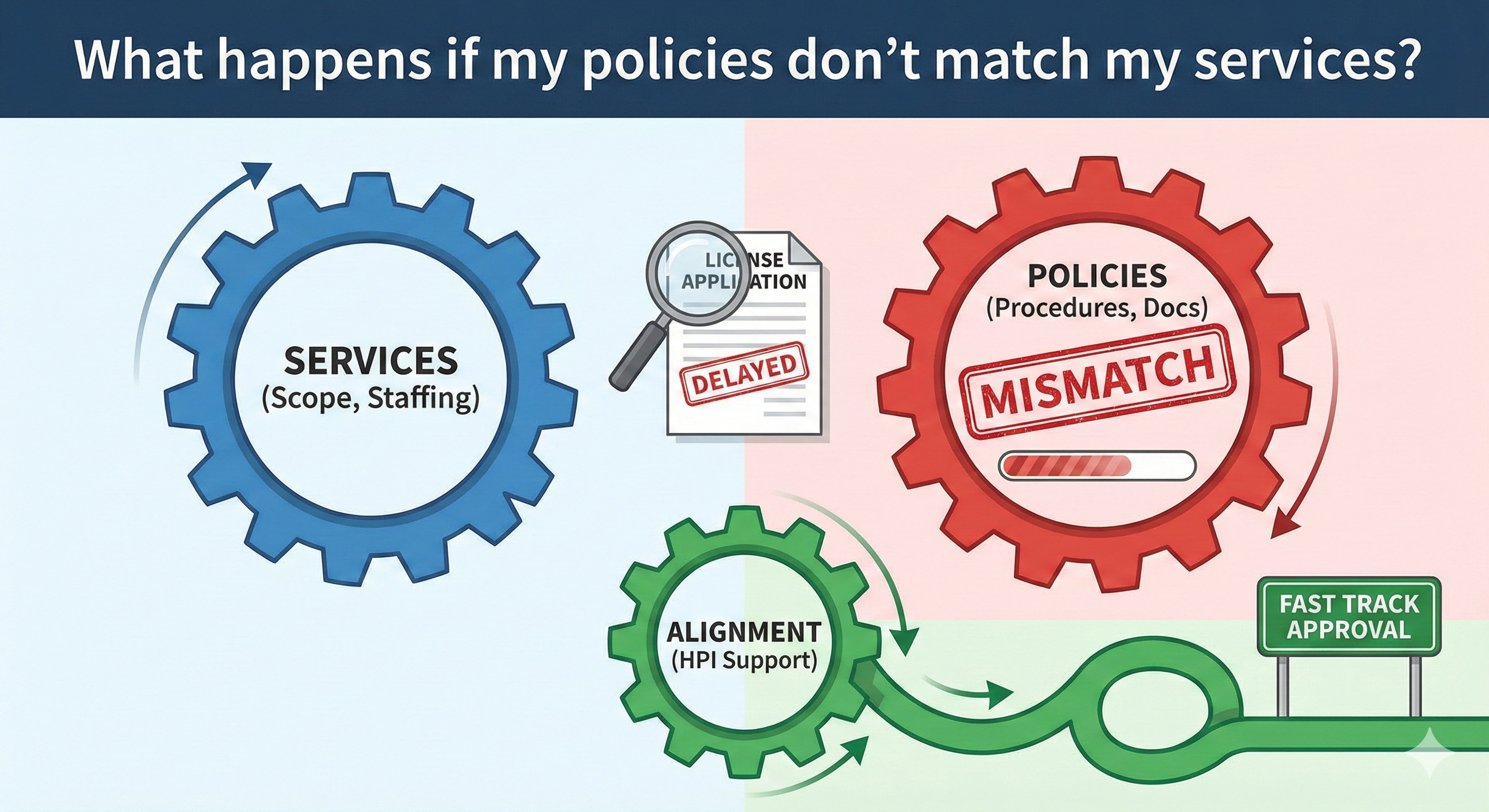
If your policies don’t match your services, your license application often stalls. Not because the reviewer dislikes your writing. Because mismatched policies make it unclear whether your agency is actually set up to deliver the service scope you described, with the right staffing qualifications, supervision structure, and required documentation. The good news: this is fixable—when you correct the setup decisions before you submit (or before you resubmit). The simple cause-and-effect of a policy mismatch Cause: Your service scope says one thing You describe the services you plan to provide. Effect: The reviewer expects your policies to support that exact service scope
"They look for policies that explain how those services will be delivered, supervised, and documented by the staff roles you listed”Cause: Your policies describe different services or a different operating model This happens when policies are copied, generic, or written for a different type of agency. Effect: The reviewer can’t confirm your setup decisions So the application submission slows down, gets questions, or is returned or delayed. How reviewers spot the mismatch quickly Reviewers don’t read policies in isolation. They compare them to: your service scope your staff roles and staffing qualifications your supervision structure your required documentation list or narrative If these don’t match, the reviewer has to pause. Common policy mismatches that stall applications.
) Policies include services you are not applying to provide What it looks like: Your service scope is non-clinical support, but your policies include treatment planning, therapy documentation, or discharge summaries. What happens next: The reviewer can’t tell what you actually plan to provide, so the file stalls while they seek clarification. 2) Policies depend on staff roles you don’t have What it looks like: A policy says, “Clinical Director reviews and approves plans,” but your staffing model has no Clinical Director (or no one qualified to fill that role). What happens next: The reviewer sees an operating model that doesn’t exist in your setup, so they stop the review until the mismatch is corrected. 3) Policies describe supervision that doesn’t match your structure What it looks like: Your policies say staff are supervised weekly, but you haven’t identified who supervises them, or your supervision structure doesn’t match your staffing plan. What happens next: The reviewer cannot confirm accountability and oversight within the model you described, so the application submission slows. 4) Policies contradict your service scope in small but obvious ways What it looks like: You say “no transportation,” but policies include transportation procedures You say “no medication support,” but policies include medication handling You describe limited hours, but policies reference 24/7 coverage What happens next: These contradictions force a reviewer to question whether your setup decisions are finalized. That usually means delay
5) Policies are too generic to prove anything What it looks like: Phrases like “as needed,” “as appropriate,” and “staff will be trained” without connecting to your actual services and roles. What happens next: The reviewer can’t confirm how you will operate, so the file stalls while they request more specific alignment. Why this slows approval timelines A licensing reviewer can only approve what they can confirm from your application submission. When policies don’t match services, the reviewer can’t confidently answer: “Does this agency’s setup match the license pathway they selected?” That uncertainty is what causes the delay. Reassurance: this is fixable with proper setup Policy mismatch is one of the most common reasons applications stall, and it’s usually not hard to correct—once you treat it as a setup alignment issue. The fix is not “rewrite everything.” The fix is to align four things: Finalize your service scope (what you will and will not provide) Confirm staffing qualifications match that scope Confirm the supervision structure matches the staffing model Update policies so they reflect the real services and real staff roles When those are aligned, policies stop raising questions—and applications move faster. Where HPI comes in (pre-application) This is exactly the kind of problem HPI prevents before submission. HPI’s setup support focuses on alignment so your policies match your service scope, staffing qualifications, supervision structure, and required documentation—before you submit the first application.
References
- COMAR 10.22.02.10 — Policies and Procedures (DDA providers must develop and adopt written policies and procedures):
https://www.law.cornell.edu/regulations/maryland/COMAR-10-22-02-10
- Application for a Residential Service Agency License (Notes that policies/procedures related to a new service are part of required attachments):
https://health.maryland.gov/ohcq/Documents/Providers/RSA/Forms/Application-for-Residential-Service-Agency-License.pdf
- COMAR 10.63.01.05 (Behavioral Health) — Example of program requirements including having and following written policy in specific areas:
https://www.law.cornell.edu/regulations/maryland/COMAR-10-63-01-05