
Welcome to Health Policy Institute
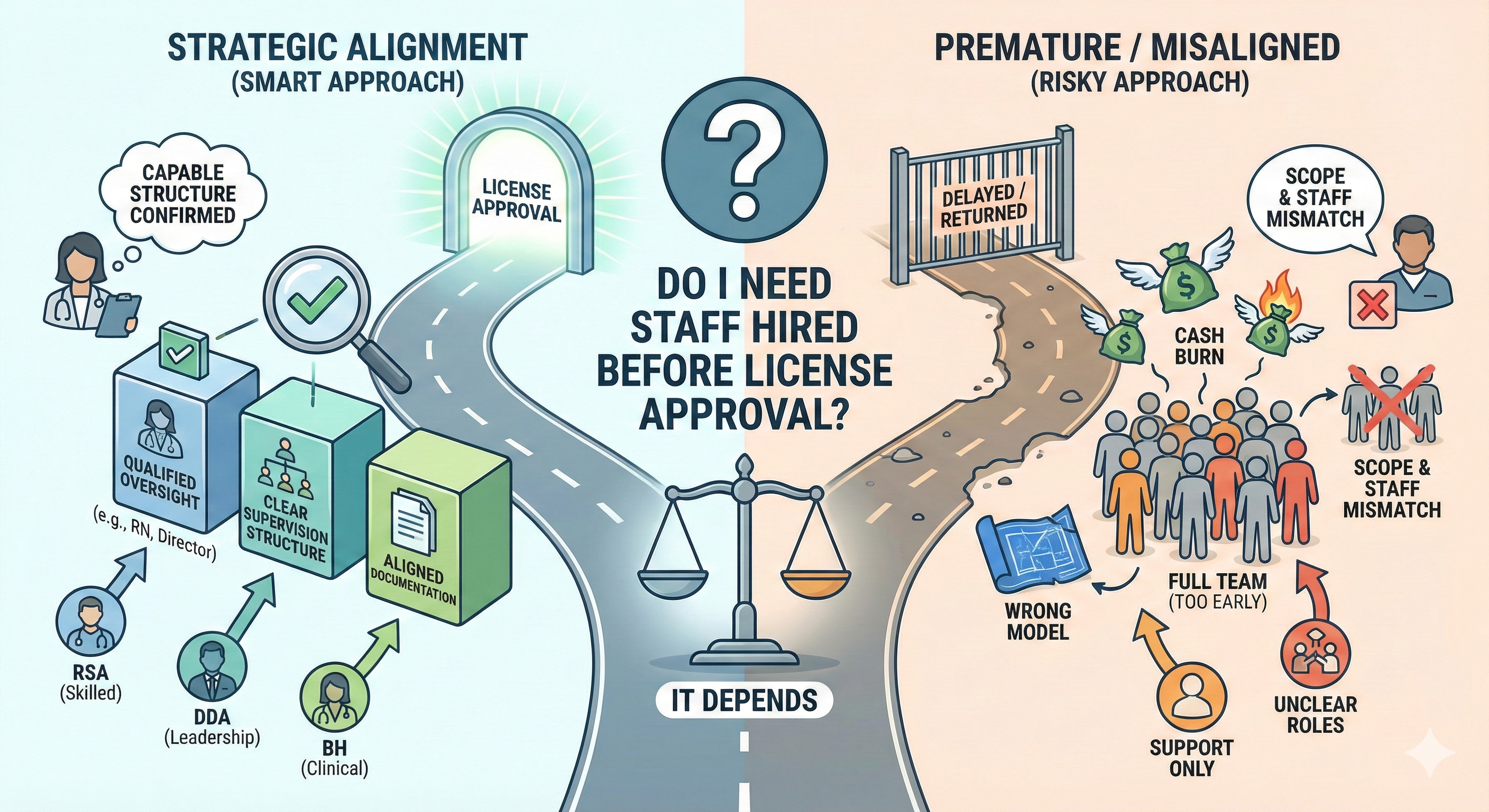
Sometimes yes. Sometimes no. It depends on the license type and what your service scope requires. Here’s the practical truth: licensing reviewers are not asking, “Did you hire a full team?” They are asking, “Is this agency set up to deliver the services described—using qualified roles, a clear supervision structure, and the right documentation?” If your staffing plan is missing key qualified roles for your license pathway, your application submission is more likely to be returned or delayed. Why the answer depends on license type Different license types expect different levels of staffing commitment before approval. The more your services depend on licensed oversight or specialized roles, the more reviewers expect you to show that those roles exist (or are formally committed and clearly defined) at the time of application. A simple way to think about it: Support-focused models often allow a lighter pre-approval staffing footprint, as long as staffing qualifications and supervision structure are clear. Clinical or nursing-driven models usually require clearer proof of qualified oversight, because services can’t be evaluated without it. Waiver and state-funded disability supports usually require proof that leadership and supervisor roles meet expectations, even if direct staff hiring ramps after approval.
What “enough staff before approval” looks like by license type 1) RSA (Residential Service Agency) When hiring early helps: RSA pathways that include skilled services or require nursing oversight often trigger reviewer attention to nursing roles and responsibilities. For example, Maryland RSA regulations include scenarios where a registered nurse assesses new clients who require skilled services and ADL assistance, and participates in care planning and assigning personnel. If your service scope includes those services, reviewers will expect your staffing model to support that RN function. Why this matters for approval: If your staffing model can’t support what your service scope describes, reviewers can’t approve the application as written. Bottom line for founders: You don’t always need a full field team hired. But if your services require RN oversight, your staffing qualifications and supervision structure must clearly show how that requirement is met. 2) DDA Provider When hiring early helps: DDA applications commonly require evidence that agency leadership and supervisory roles meet experience and training expectations. Maryland’s DDA provider application, for example, asks agencies to submit resumes for leadership and supervisors overseeing waiver services. DDA regulations also require the provider to implement a staffing plan that supports individuals’ needs and the services identified in their plans. Why this matters for approval: If you haven’t identified qualified leaders/supervisors, the reviewer can’t confirm your agency can run the model you’re applying for—even if you plan to hire direct support staff later. Bottom line for founders: You may not need every direct support role hired pre-approval, but you typically do need the leadership/supervision structure and qualifications clearly established. 3) Behavioral Health When hiring early helps: Behavioral health is usually the least forgiving when the service scope implies clinical services but the staffing plan doesn’t show qualified clinical oversight. Maryland behavioral health rules include pre-licensure requirements that programs must address before applying (for example, a cooperation agreement requirement). In addition, behavioral health program categories often have defined staffing expectations and role requirements (e.g., program director expectations are common across program types). Why this matters for approval: If your service scope is clinical, reviewers need to see a staffing model and supervision structure that make clinical accountability real—not aspirational. Bottom line for founders: You may be able to delay hiring a full caseload team, but you should not treat clinical oversight roles as “we’ll hire later” if your service scope depends on them. When hiring before licensure causes problems.
Hiring early creates problems when it locks you into the wrong model. 1) You hire for a service line before you finalize your service scope If you hire a behavioral health team but apply under a support-services license (or vice versa), you end up rewriting the application around your payroll instead of around the correct license pathway. 2) You hire people with the wrong credentials for the pathway This is common with supervisors and directors. People can be experienced and still not meet the staffing qualifications expected for the license type you chose. 3) You build a supervision structure that looks good on paper but can’t work Reviewers can spot when one person is “supervising everything” across a complex service scope. That usually leads to questions, delays, and revisions. 4) You burn cash while the approval timeline is uncertain Licensing timelines move when the application is complete and aligned. Payroll doesn’t wait. If you hire too early, delays become financially painful. How staffing decisions affect licensing approval Reviewers use staffing to test whether your setup decisions are coherent: Does the service scope match the license type? Do staffing qualifications match the services described? Is the supervision structure clear and realistic? Do your policies and required documentation assign responsibilities to roles that actually exist? If those don’t match, the application submission can be returned or delayed. A practical decision rule (high-level) Hiring before approval makes sense when you are hiring the roles that prove your setup is real: The leader responsible for operations under the license The supervisor role that makes your supervision structure credible The qualified oversight role required by your service scope (especially in clinical or nursing-driven models) Hiring before approval causes problems when you hire a full team before you’ve confirmed: the correct license pathway the final service scope the staffing qualifications that pathway expects.
Where HPI comes in (pre-application) This is a common place founders lose months and money: staffing decisions made before the license pathway and service scope are stable. HPI helps you make the decision the right way—by aligning: your license type to your service scope staffing qualifications to that scope a supervision structure reviewers can actually approve policies and required documentation that match the staff roles you claim you’ll use That’s how you avoid hiring too early, hiring the wrong roles, or having to redesign the agency after submission.
References
- Maryland RSA Licensing Overview (OHCQ):
https://health.maryland.gov/ohcq/Pages/Residential-Service-Agencies.aspx
- Maryland RSA License Application (shows required attachments and that nonconforming submissions may be returned):
https://health.maryland.gov/ohcq/Documents/Providers/RSA/Forms/Application-for-Residential-Service-Agency-License.pdf
- COMAR 10.07.05.12 (RN assessment and care planning expectations in certain RSA service scenarios):
https://www.law.cornell.edu/regulations/maryland/COMAR-10-07-05-12
- Maryland DDA Provider Application (resumes for leadership/supervisors overseeing waiver services):
https://health.maryland.gov/dda/Documents/DDA%20Provider%20Application%20-%20Revised%2008-11-23.pdf
- COMAR 10.22.02.11 (DDA staffing plan requirement):
https://www.law.cornell.edu/regulations/maryland/COMAR-10-22-02-11
- COMAR 10.63.01.05 (Behavioral Health pre-licensure requirement example):
https://www.law.cornell.edu/regulations/maryland/COMAR-10-63-01-05