
Welcome to Health Policy Institute
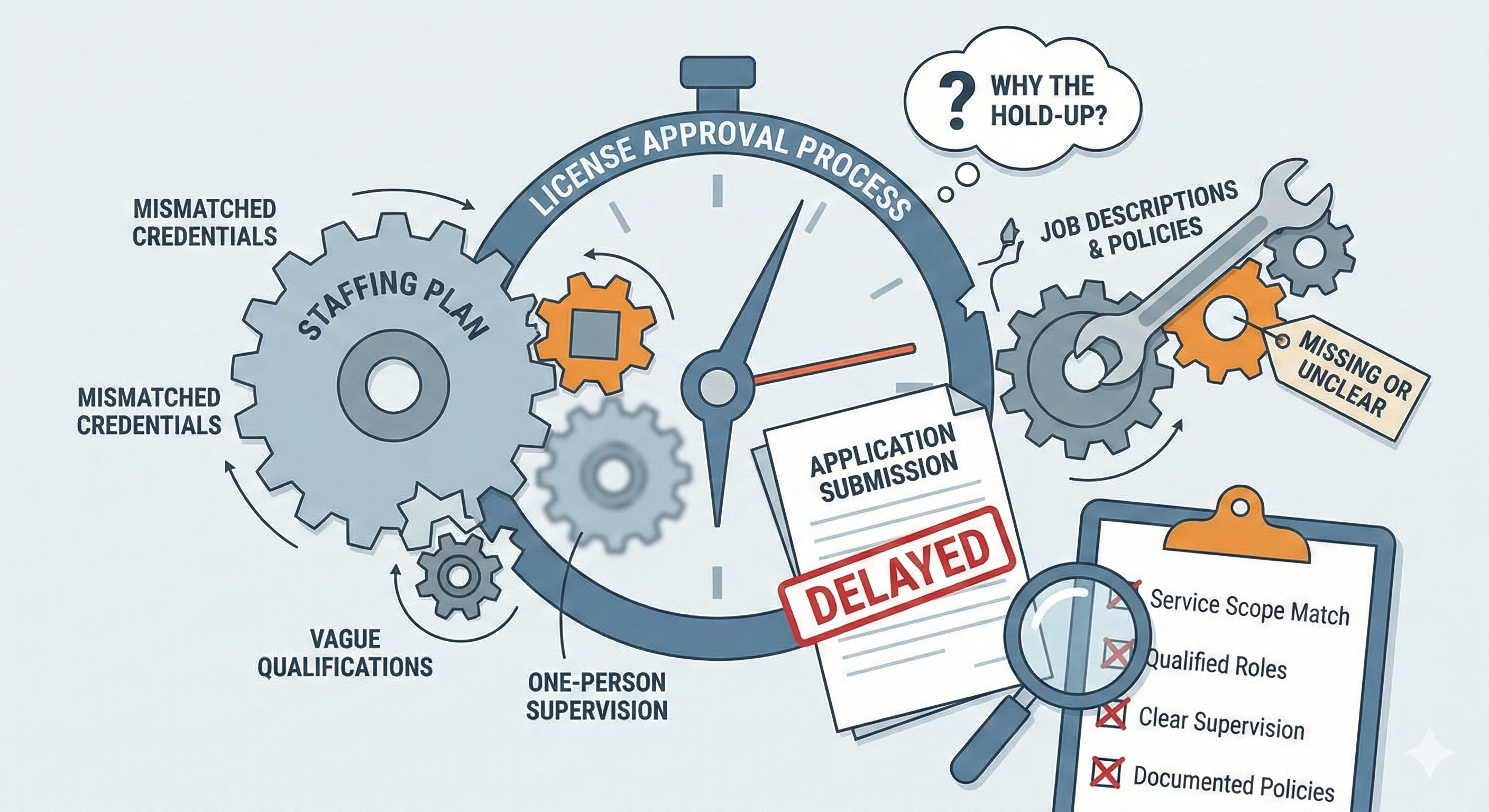
Staffing is one of the fastest ways to trigger a returned or delayed application. Not because you hired “bad people,” but because licensing reviewers need to see that your service scope, staffing qualifications, supervision structure, and required documentation all match. Below are the most common staffing mistakes that slow the approval timeline—written in plain language, with real-world examples. 1) Your staffing credentials don’t match your service scope What it means: Your services read like they require licensed or specialized staff, but your staffing plan doesn’t show those qualifications. Example: You describe clinical behavioral health services, but your staffing list is mostly support staff with no clear licensed clinical coverage. For certain behavioral health programs, Maryland regulations specifically require a qualified program director and a job description tied to duties. Why it delays approval: Reviewers can’t approve services that aren’t supported by staffing qualifications. 2) You list job titles, but not the required qualifications What it means: You wrote “Program Director,” “Supervisor,” or “Clinical Lead,” but you didn’t clearly show what credentials the role must have. Example: In Maryland’s behavioral health crisis service center rules, the program director must meet specific qualification expectations and those duties must be defined in a job description. Why it delays approval: Reviewers can’t confirm you meet staffing requirements if qualifications are vague.
3) Missing job descriptions (or job descriptions that don’t match what the role is doing) What it means: You have staff positions listed, but you don’t show what each role is responsible for—or your descriptions don’t match the services you claim you provide. Example: Your application says the supervisor reviews documentation and oversees service delivery, but the job description reads like a scheduling coordinator. Why it delays approval: Reviewers use job descriptions to verify your supervision structure and accountability. If duties are unclear, the reviewer has to pause. 4) Unclear supervision structure What it means: It’s not clear who supervises whom, or who is accountable for service delivery. Example: You say staff are supervised “as needed,” but you don’t identify the supervisor role, frequency, or who signs off on key decisions. Why it delays approval: Reviewers need to see a supervision structure that makes sense for your service scope and staffing plan. 5) One person is listed as supervising everything What it means: The org chart shows a single leader supervising all services, all staff, and all documentation—regardless of service complexity. Example: A founder lists themselves as administrator, HR, clinical supervisor, and program director across multiple service lines. Why it delays approval: Reviewers see this as unrealistic for the service scope you described. It raises questions about whether the agency can operate as written.
6) Staff roles and policies don’t match What it means: Your policies assign responsibilities to roles that aren’t in your staffing plan—or your staffing plan has roles your policies never mention. Example: Policies reference a “Clinical Director” approving plans, but there is no Clinical Director role in the staffing model. Maryland behavioral health definitions include a Clinical Director role responsible for clinical oversight, which makes mismatches easy for reviewers to spot. Why it delays approval: Reviewers compare policies to staffing. When they don’t match, they assume your setup decisions are not finalized. 7) You’re hiring for the wrong license pathway What it means: Your staffing model looks like it belongs to a different type of agency than the license you’re applying for. Example: You hire a home-care style staffing mix but apply under a behavioral health program pathway—or you staff like a clinic but apply under a support-services pathway. Why it delays approval: The staffing model becomes evidence that the license choice and service scope are misaligned. 8) You rely on “we’ll hire later” for critical roles What it means: Your service scope depends on credentialed oversight, but your plan is to fill those roles after approval. Example: “We will hire a licensed supervisor after we get licensed.” Why it delays approval: Reviewers can only evaluate what is supported in the application submission. If a key role is missing, the file often stalls.
Quick self-check before you submit If you answer “yes” to two or more, you’re at risk for delays: Our service scope requires credentials we haven’t clearly shown Our job descriptions are missing or generic Our supervision structure is unclear Our policies reference roles we don’t have Our staffing model feels like it belongs to a different license type Bottom line Staffing mistakes delay approval when they create mismatch between service scope, staffing qualifications, supervision structure, and required documentation. Fixing it usually doesn’t mean hiring a huge team. It means making sure the staffing plan matches what you’re applying to do—and that your job descriptions and supervision structure make sense on paper.
References
- Maryland Office of Health Care Quality (OHCQ) — Residential Service Agencies overview (RSA scope and regulator): https://health.maryland.gov/ohcq/Pages/Residential-Service-Agencies.aspx
- COMAR 10.63.03.21 — Behavioral Health Crisis Service Center staffing requirements (program director qualifications and job description requirement): https://www.law.cornell.edu/regulations/maryland/COMAR-10-63-03-21
- COMAR 10.63.01 Requirements PDF (Behavioral Health) (definitions including “Clinical Director” responsible for clinical oversight): https://health.maryland.gov/bha/Documents/COMAR%2010.63.01%20Requirements%20for%20All%20Licensed%20and%20Certified%20Programs%20%282%29.pdf
- COMAR 10.22.02.10 — Policies and Procedures (example of required documentation expectations for DDA providers): https://www.law.cornell.edu/regulations/maryland/COMAR-10-22-02-10