
Welcome to Health Policy Institute
A founder told me, “We’ve got clients waiting. We’re going to start next week and fix the license later.” That’s the moment agencies accidentally step into the danger zone. In most cases, you cannot legally operate the service you’re applying for until you have the approval in hand. And even if you could provide something limited, you usually cannot bill Medicaid until your enrollment is active. So the safer question is: What can I do while waiting that moves me forward without risking a shutdown, non-payment, or a returned application? Why starting early is usually not allowed Licensing is permission to operate a specific service model. Until it’s granted, you’re not approved to deliver that service as a business. Here’s how regulators see it: If you’re not licensed yet, you’re not authorized yet. For example, Maryland’s RSA application instructions state a person or entity may not conduct or operate a Residential Service Agency without first obtaining a license from the Office of Health Care Quality (OHCQ). That’s clear language: no license, no operation. Behavioral health has similar language in Maryland’s COMAR 10.63 regulatory hub: a program may not operate without a license under that subtitle. In plain terms: most “start anyway” plans are not a workaround. They are operating outside approval.
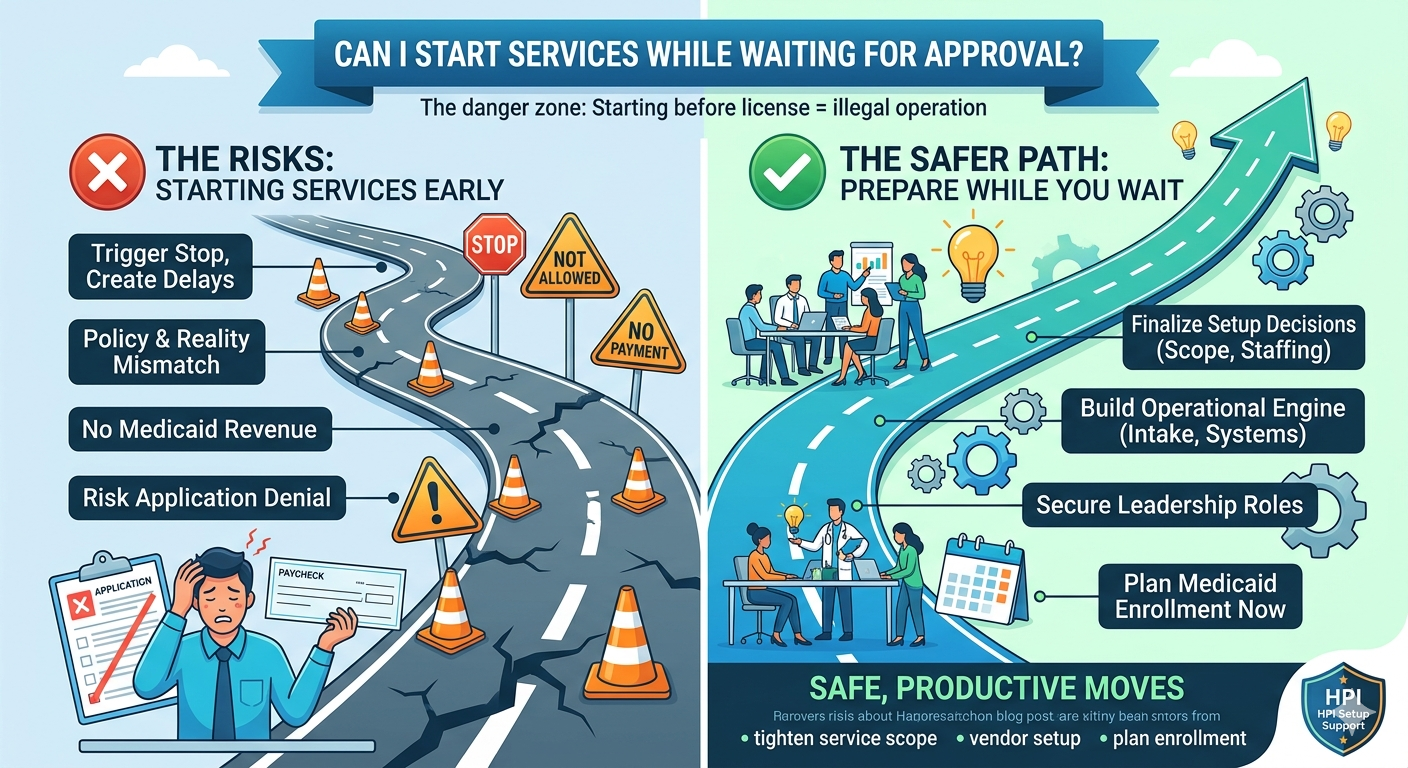
""Why starting early usually backfires (even if you have good intentions) 1) It can trigger a stop instead of speed If a regulator learns you’re operating before approval, it doesn’t help your timeline. It usually creates complications. 2) It creates document mismatch When you start operating early, your real-world services often drift from what you submitted. Then your policies, staffing plan, and service scope no longer match your application submission—leading to delays or returns. 3) Medicaid payment is still not available Even if you could legally provide some services, Medicaid payment is a separate gate. In Maryland, ePREP guidance and payer materials emphasize that enrollment status matters for payment, and providers with out-of-date or inactive enrollment may not be paid. A simple rule that protects agencies: No active enrollment = no reliable Medicaid revenue.
What to do instead while you wait (safe, productive moves) You can still move your agency forward without delivering services before approval. 1) Finalize setup decisions so your application doesn’t get returned This is the best use of the waiting period: • tighten your service scope (what you will and will not provide) • confirm staffing qualifications match that scope • clarify the supervision structure • align required documentation (policies) to your real model This is how you prevent the “returned or delayed application” loop. 2) Build your operational engine Use the time to prepare what will make launch smooth: • intake workflow (without serving yet) • scheduling and staffing systems • documentation templates aligned to your services • vendor setup (payroll, insurance, EMR, phone system) 3) Hire only the roles that support approval and readiness This is not the moment to hire a full field team. It is the moment to secure key leadership or oversight roles that your license type expects, so your supervision structure and staffing qualifications are credible on paper. 4) Plan Medicaid enrollment during licensing Don’t wait until approval to start thinking about Medicaid. Plan the enrollment lane now so you’re not adding months after licensing is granted.
A quick reality check founders appreciate If you’re asking, “Can we start while waiting?” you’re usually feeling one of these pressures: • clients are waiting • referral partners want a start date • you already hired staff • you need revenue fast That pressure is real. But starting services before approval typically creates bigger delays and bigger financial problems later. The smarter move is to use the waiting time to remove the reasons licensing and Medicaid enrollment stall: unclear service scope, staffing mismatches, vague supervision structure, and generic policies. .
Where HPI comes in (setup only) This is exactly what HPI helps with before launch: making sure your agency is set up correctly so you’re not tempted to “start anyway.” HPI supports: • choosing the right licensing pathway for your service scope • aligning staffing qualifications and supervision structure • aligning required documentation (policies) to your services • planning Medicaid enrollment during licensing so revenue doesn’t get delayed twice Bottom line In most cases, starting services while waiting for approval is not allowed, and it often creates bigger delays and non-payment problems. The safer path is to use that waiting period to strengthen setup, keep your application submission consistent, and line up Medicaid enrollment so you can launch clean and get paid.
References (Clickable)
- Maryland RSA Application Instructions (states you may not conduct/operate an RSA without first obtaining a license): https://health.maryland.gov/ohcq/Documents/Providers/RSA/Forms/Application-for-Residential-Service-Agency-License.pdf
- COMAR 10.07.05.03 — “License Required” (RSA): https://mdrules.elaws.us/comar/10.07.05.03
- Maryland Behavioral Health Regulations Hub (COMAR 10.63) (“a program may not operate … without a license”): https://health.maryland.gov/regs/Pages/10-63-01-10-63-06-Behavioral-Health-Regulations-%28.aspx
- Maryland Medicaid ePREP Enrollment Reminder (providers who don’t enroll or have out-of-date information may not be paid; active enrollment required): https://www.marylandphysicianscare.com/wp-content/uploads/2020/12/013120ePREP.pdf